COMPASS Market APP Is HERE!

Tap to download

Knowledge is power. Being able to access the smartest and most relevant real estate data at just the right time is critical to home sellers and buyers. With Compass Markets, homeowners and agents can build market-specific reports and get real-time information on the go to provide answers to real estate’s most difficult questions.


Compass Markets is:

• Custom and specific: Create market comparisons using just the data you need. 
• Real-time and relevant: Access the latest market activity as well as long-term trends from multi-year transaction histories. 
• Instant and immediate: Empower yourself with data at your fingertips, when and where you want it.

Compass combines best-in-class technology with exceptional agents to make the process of buying and selling a home intelligent and seamless. Learn more about us at Compass.com.

On Governors Island, The World’s Smartest Hill

I took the 7-minute ferry ride from Lower Manhattan to Governors Island last September with a cluster of other journalists. All of us donned OSHA orange safety vests and hard hats, and rode in a caravan of golf carts to see four built-from-scratch hills that, at the time, simply looked like unremarkable mounds of dirt.

Along the way, the expedition leader, 55-year-old Dutch landscape architect Adriaan Geuze, whose firm West 8 won a 2007 competition to design a 40-acre park on the island, waxed poetic about everything from the hum of the park’s new insect population to the prominent white borders that line the park’s new pathways. "They’re soft, like ivory," he said.

Geuze’s firm established an international reputation with the debut of the Schouwburgplein (Theater Square) in the firm’s hometown of Rotterdam. The otherwise understated design incorporated a series of striking red lamp posts shaped like shipyard cranes with coin-operated controls that allowed members of the public to maneuver them. When it opened in 1996, the idea of a civic space that incorporated electronics just for fun was a revelation, a harbinger of a technologically driven approach to urban culture.

The Hills are a perfect example of the hallmark of 21st century design: objects that are hybrids, part manmade and part natural.

The Hills, by contrast, don’t look much like harbingers of anything. Really, they’re just hills. Each has a descriptive name: Grassy, meant for quiet relaxation, is the shortest at 25 feet. Slide, equipped with a quartet of slides, and Discovery, with a nature trail that wends its way to a wee concrete cabin that is actually a Rachel Whiteread sculpture, are each 40 feet tall.

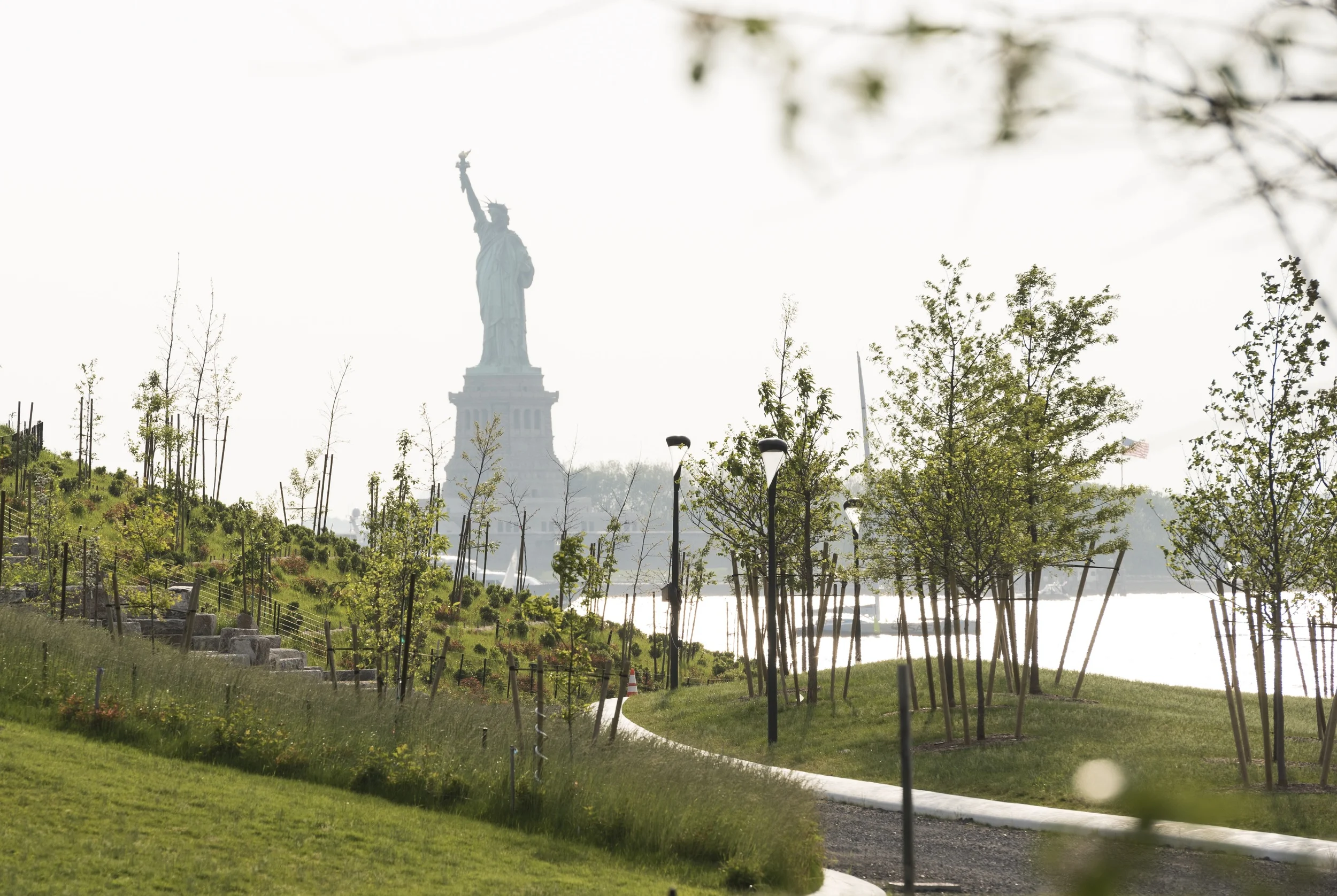
The highest is Outlook, which, at 70 feet, offers a 360-degree view of New York Harbor, a perspective that’s never previously existed. Out in the middle of the harbor, despite being squat compared to, say, the Empire State Building or 1 World Trade Center, Outlook allows you to see all the way to the Verrazano Narrows Bridge where the open ocean begins, to the Statue of Liberty, to the towers of the Financial District, and to the newly burgeoning skyline of Downtown Brooklyn.

Still, a view is just a view. It wasn’t the thing that intrigued me about The Hills. Rather, my curiosity was piqued by remarks made by the project’s geotechnical engineer, David Winter, the CEO of Seattle-based Hart Crowser. "We made a lighter hill," he told the assembled group. "We’ve got settlement sensors everywhere."

Suddenly, I realized that The Hills are a perfect example of what I’ve come to believe is the hallmark of 21st century design: objects that are hybrids, part manmade and part natural. Apartment towers that double as forests, urban rooftops that double as farms, corporate headquarters that double as indoor rainforests. We’re beginning to see a lot of doubling. The boundaries that differentiate urban from rural, and natural from artificial, are getting harder to draw.

On a sizzling July morning, I return to look at The Hills with new eyes.

I rendezvous on the ferry with the outgoing President and CEO of the Trust for Governors Island, Leslie Koch. For a decade, she’s been leading the effort to reshape the island into a destination for day trippers and development (33 acres are currently available for real estate projects). She's stepping down in August, weeks after her epic undertaking opens to the public on July 19.

A whip-smart native of Manhattan’s Upper West Side, Koch, 54, spent her early professional life on the west coast as a marketing executive at Microsoft. She talks me through the genesis of The Hills on the ride over.

In 2006, what was then called the Governors Island Preservation and Education Corporation issued a Request for Qualifications. "We had very specific goals for [the] park, aspirations," Koch recalls. In fact, the RFQ laid out the park’s ideals in flowery language, just this side of Walt Whitman, explaining that it "will be a place to cultivate and indulge in sensory experience and delight—to experience the salt air, fresh air, sunlight, waves, wind and white noise of nature."

"But," Koch stresses, "there was no concept of height."

Along came Geuze, from a country where land is routinely reclaimed from surrounding waters and where lifting the ground above sea level was a survival skill even before global warming. Geuze, who hides his brilliance behind boyish insouciance, explains to me that the original island was a "rock" upon which fortifications like Fort Jay and Castle Williams were built in advance of the War of 1812.

Around 1910, fill generated by the excavation of the Lexington Avenue subway added 103 flat, featureless acres to the island, for a total of 172. So the island itself is an example of manmade nature.

"The military made it flat," Geuze points out. And what can you do with an island that mostly sits below the 100 year flood line? Geuze’s answer: "We could have made a brackish swamp." But, of course, that wasn’t what he proposed.

In 1996, the idea of a civic space that incorporated electronics just for fun was a revelation.

Koch recalls that in his first presentation to the competition jury in January 2007, Geuze showed "the idea of The Hills in sketch. With a marker. A hill on island." The jury winnowed the field down to five finalists, West 8 among them, and then down to two.

Koch describes the final decision process: "We went to the top of Building 877, an 11-story building." The structure, an undistinguished apartment complex built in the 1960s by the Coast Guard and imploded in 2013, stood on roughly the location Geuze had chosen for his hills.

"We walked up 11 flights of stairs in an abandoned building and stood on a spongy tar roof and looked at the view," Koch says. And that’s when she realized how much altitude could pump up that sensory experience she’d envisioned. After a round of due diligence (How much does it cost to build a hill? Is it even possible?) West 8 was commissioned to create a whole new topography for Governors Island.

I ask Geuze, "Why hills?" His response is to deny that the four landforms known as Grassy, Slide, Discovery, and Outlook even exist. In his mind, they are indistinguishable from all the smaller undulations with which he’s covered 40 acres of island. "I think we have a rolling landscape," he insists.

We tend to forget that the tightly gridded, skyscraper-packed isle of Manhattan (of which Governors Island is officially a part) was once a verdant natural place. The Lenape tribe who inhabited the island before the Europeans came along called it the "Island of Many Hills."

Landscape ecologist Eric Sanderson, whose Mannahatta: A Natural History of New York City (Abrams, 2009) convincingly reconstructs what the European settlers found when they arrived, has calculated that there were once 573 hills in Manhattan. The tallest ones, of course, were in the island’s rugged northern reaches.

In 1996, the idea of a civic space that incorporated electronics just for fun was a revelation.

But in Lower Manhattan, one called Bayard’s Mount was an impressive 110 feet tall. Murray Hill—which you only notice if you bicycle in or out of Midtown—was once "a large two-tiered structure, from which springs flowed," according to Sanderson, between 80 and 100 feet tall. Hills were methodically leveled as Manhattan was developed and the 1811 plan for the urban grid was implemented. No one saw any reason to build new hills.

Even Frederick Law Olmsted, the revered landscaper of Central Park, who crafted a pastoral fantasia out of land too rocky or swampy to have much value to real estate interests, didn’t build hills. "They could take a hill away or dam a stream," wrote Sanderson, "but they couldn’t lift up a hill and move it 30 yards to the right."

Olmsted built no hills, but in other respects he was the inspiration for West 8’s work. When I meet with principal landscape architect Jamie Maslyn-Larson, 46, who ran the Governors Island project out of West 8’s New York office, she tells me that the team’s mantra was, "What would Olmsted do?"

His influence is obvious. The new paths on Governors Island, often lined with thickets of greenery and wildflowers, meander. When you climb Outlook Hill on the paved path (instead of on the scramble built from remnants of an old sea wall) you do it gradually. The grade is less than five percent (making it ADA compliant), and switchbacks slow your progress. The strategy originated with Olmsted, who, on his second great work, Brooklyn’s Prospect Park, never made pathways that ran in a straight line and used landscape design to enhance the perception of space.

West 8 similarly took the "flat flat flat" terrain of Governors Island and manipulated it to make it feel like a place worth exploring. "When we started working with topography, we created mini thresholds, inviting spaces for people to go to, like breadcrumbs," Maslyn-Larson explains. "As you’re walking through the park, you have these undulating frames in combination with walkways. The topography makes a really lovely walk."

On the other hand, there’s a basic philosophical difference between Olmsted’s parks and the one that firms like West 8 build today. Olmsted wanted to allow city dwellers to hide from the city, to immerse themselves in an Edenic illusion. He took care to keep his park visitors looking inward, toward the greenery and away from surrounding buildings.

Today’s premier parks—the High Line comes to mind—tend to emphasize their urban surrounding while also rewarding visitors with tall grasses, cultivated wildflowers and cushy places to sit. They are a hybrid form, merging the city and the country. The two are no longer opposites. Geuze calls Governors Island "the smallest vacation you can take." But what you see when you get there is New York City from a new perspective.

The first phase of the West 8 scheme consisted of some basic landscaping. The team built the low-lying areas up with fill, planted them with trees that would be able to survive the island conditions, and carefully sculpted the newly made land. This process was underway when Hurricane Sandy hit in October of 2012.

Koch, alarmed by reports of flooding and uprooted trees across New York, returned to the island as soon as she could and discovered that the newly landscaped areas of the island were "dry as a bone" and only eight of 1,700 trees in the island’s historic district had been lost.

Sandy demonstrated that West 8’s approach was "resilient" before anyone in New York had a clue what that term meant. Koch says that Sandy was "a stress test for Adriaan’s strategy." Suddenly the project’s second phase, the construction of The Hills, became not just a lovely ideal, but something essential for the ongoing survival of the island.

That The Hills were now seen as part of the island’s resilience strategy was a good thing because, as it turned out, they were not so easy to build. Initially, they were supposed to be simple piles of fill. It didn’t matter too much what kind. "As long as it drains and as long as it would compact well, we would take it," says Maslyn-Larson.

The original idea was that The Hills would be composed of demolition waste from the implosion of Building 877 and others. "These buildings were taken down and the concrete and the brick were crushed and processed into eight-inch size or smaller for use inside the hill," Winter says.

There wasn’t enough usable debris, so dirt and gravel was imported from upstate quarries and brought in by barge. The dirt was, as you might imagine, cheap, but it also weighed too much. "When we did the geotechnical tests at the end of design development, we found out this spot was the weakest part on all of Governors Island," Maslyn-Larson says.

"There’s about a hundred feet of loose crappy soil before you get down into the hardpan and the bedrock," engineer Winter explains to me in a phone conversation. There were two potential problems. One was simply that the extra weight would cause the underlying fill to settle too much and Outlook would sink. Worse, Winter says, "there was a risk that there’d be instability and a massive failure as you were building the hill and it would slip off into New York Harbor."

They could, of course, have moved the biggest hill back, away from the shoreline and onto sturdier ground, but that would have ruined the desired effect, a total immersion in the sights and smells of the harbor. Instead, the hill had to get smarter, less natural and more manmade.

Winter and the other engineers on the project had never exactly built a hill before. But some of them had worked on sharp-edged, distinctly unnatural looking, multi-layered terrain for Seattle’s Olympic Sculpture Park. So Winter borrowed ideas from that project, and from mundane disciplines like parking lot construction.

He began working with West 8 to create a 3D computer model of Outlook Hill, one that would show how the size, shape, and composition of the hill might impact the underlying fill. Gradually they began to shift the biggest hill’s weight by sculpting it, making some of the slopes closest to the water’s edge steeper and strategically depositing lighter material in the portions of the hill over the least solid ground.

"We could have made a brackish swamp." - Adriaan Geuze, West 8

One idea for solving the weight problem was to fill the hill with a lightweight product called GeoFoam. "These are just big blocks of Styrofoam," Winter explains. "And they come 4x4x8 foot blocks. You can cut into any shape you want. We were going to construct the big hills out of Styrofoam."

Maslyn-Larson says they were looking at using the foam for the last 10 or 15 feet of the hill before the topsoil. But GeoFoam is expensive and hard to install in a windy waterfront location. "We didn’t like the idea of using foam in the hill. It didn’t feel right. It isn’t a natural material," she explains.

Natural is a relative term. On the steeper parts of both Discovery and Outlook hills, for example, a building technique called Mechanically Stabilized Earth (MSE) was used to prevent erosion. Long sheets of special plastic fabric called Geogrid were layered with fill. Geuze described the structural system, typically used in highway construction, as lasagna. Maslyn-Larson explains: "The pressure from the material is creating tension against this material which makes it really tight and strong. So it self supports."

Outlook Hill is also crammed with electronics. Monitors buried within measured how well and how quickly the fill was settling. "We had deep settlement sensors that went all the way down to the bedrock, so we know where the settlement was occurring and at what rate," Winter says. Settlement, when controlled and timed, is an asset. It makes the underlying fill stronger.

In the end, the solution to Outlook Hill’s weight problem was pumice, a volcanic rock. "It weighs about half of what regular soil weights," according to Winter. Mostly it was used in the part of the hill closest to the water. "Maybe one third of the hill got this lightweight fill."


Slide Hill features four slides, including the longest slide in New York City (57 feet long)

Timothy Schenck/Courtesy West8

At West 8’s New York office, Maslyn-Larson walks me through the construction documents, comprising a large-format book of some 400 pages. In these pages is every detail from the composition of the grass seed mixes to the placement of wire baskets used to control erosion on the steepest slopes. It’s enough detail, one would think, to build a supertall tower or a Gehry Guggenheim. God—or whoever or whatever built Manhattan’s original 573 hills—surely did not do this much work.

"In the end these are just big piles of dirt," Winter acknowledges. Then he corrects himself. "I mean, they’re engineered piles of dirt."

"What separates an engineered pile of dirt from an un-engineered pile of dirt?" I ask.

"Well, an un-engineered pile of dirt out there would have slipped into the ocean."

But here’s the most amazing thing about this engineered pile of dirt. All the thousands of shrubs and hundreds of trees will, presumably, thrive, thanks to built-in irrigation and drainage systems. And eventually nature will take over the job of stabilizing the hills.

As Maslyn-Larson points out, "Their root structure provides the stability." So, at some juncture, this rigorously engineered, technologically sophisticated mound of rubble, dirt, pumice, and plastic GeoGrid becomes—Pinocchio style—a real hill.

If you visit Governors Island and climb to the top of Outlook, forget about the view for a moment and think about the hill beneath your feet. Consider the fact that it’s a synthetic object, crafted by experts. A skyscraper or a bridge will always reveal the handiwork of its creators, but this artificial hill, if its designers did their jobs right, will someday be just another hill, a technological product that transitions over time into a natural feature.

Or, as Maslyn-Larson says, "It won’t need us anymore."

This Week’s 5 Most Expensive Listings

Here’s our look at the five most expensive residential listings to hit StreetEasy in the past seven days — the crème de la crème of the Manhattan market this week.


50 Riverside Boulevard #21B

Address 50 Riverside Boulevard #21B
Price $21,000,000
Type/Size Condo: seven bedrooms and nine bathrooms
This spacious spread is the most expensive listing to hit the market this week and it should come as no surprise that the 6,056-square-foot pad, which is set on the Hudson River-facing Riverside Boulevard, has some very pretty views. It also comes with a double height living room, a library and most impressive of all – a private outdoor pool.


25 Columbus Circle #54AG

Address 25 Columbus Circle #54AG
Price $20,000,000
Type/Size Condo: four bedrooms and four bathrooms
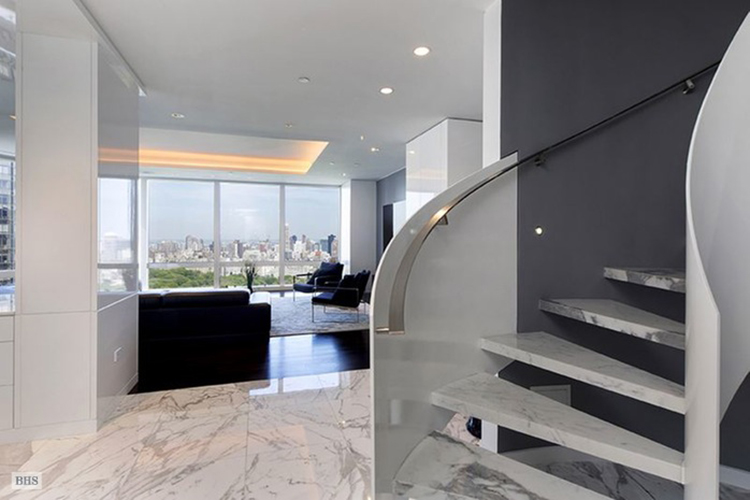
The second priciest listing this week is this Time Warner Center duplex. It’s set across the 54th and 55th floors of the famed building and has 10-foot ceilings, floor-to-ceiling windows and a curved staircase. It looks as though it’s been on the market since 2014, but has had a major price cut from the $42.5 million it was originally asking.


10 West Street #Ph2a

Address 10 West Street #Ph2a
Price $13,500,000
Type/Size Condo: four bedrooms and five bathrooms
If there’s one thing all these listing share, it’s impressive views. In this case, they’re from the top of the Ritz Carlton, Battery Park. Residents get access to a private entrance, while the home itself comes with high ceilings, big rooms, a 305-square-foot private terrace and herringbone floors to die for.


1049 Fifth Avenue 18B–M8

Address 1049 Fifth Avenue 18B–M8
Price $12,500,000
Type/Size Condo: three bedrooms and four bathrooms
According to its listing, this Fifth Avenue home has been on the receiving end of a complete and extensive renovation. And judging by the photos, it was worth it. The 2,925-square-foot spread comes with Central Park views, a separate staff apartment and a library with an upholstered wall of Oxblood leather. Fancy, of course, but not as fancy as a room lined in Hermès leather à la 8 East 62nd Street.


160 West 12th Street #96

Address 160 West 12th Street #96
Price $9,995,000
Type/Size Condo: three bedrooms and three-and-a-half bathrooms
According to StreetEasy this pretty Greenwich Village spread was sold last month for $8.5 million. Already it’s back on the market, and with a hefty $1.5 million added to the price tag. It’s owned by an anonymous LLC, so perhaps we’ll never know who’s trying to make a quick profit, but at least they have good taste. The pad comes with beamed ceilings, solid oak floors and a private terrace.

Cost Of LaGuardia Redevelopment Flies Up To $8B!

It appears the estimated cost of redeveloping LaGuardia Airport has climbed by about $1 billion.

According to an agenda released by the Port Authority of New York and New Jersey Friday, the redevelopment of the Terminals C and D will cost $4 billion — $1 billion more than Gov. Andrew Cuomo has previously announced. Delta Airlines, which is leasing the terminals, is currently in the early stages of designing the new terminals.

At the groundbreaking for construction at Terminal B last month, Cuomo announcedthe total project — the redevelopment of terminals B, C and D — would weigh in at an estimated $7 billion, with Delta’s terminals accounting for roughly $3 billion of the bill. Representatives for the governor could not immediately be reached for comment.

The agency will contribute up to $600 million to the construction of these terminals, which will connect to Terminal B, according to agenda documents for next week’s meeting. Port Authority  is expected to vote on its contribution to the project on Thursday.

Cost changes for major infrastructure projects are fairly common — one extreme case is the World Trade Center Transportation Hub, whose final tab was at least double its $2 billion estimate.

The price tag attached to the airport’s redevelopment has been a sore spot for some Port Authority board members. At a meeting in March, a few of them squabbled over whether the cost of the Terminal B redevelopment would cost $4 billion or $5.3 billion — the discrepancy hinging on whether or not previous work done onsite should factor into the total projected bill.

Officials have long touted the project as one of the biggest private-public partnerships in the country, since a majority of the project is funded from private resources. LaGuardia Gateway Partners — which includes Skanska, Vantage Airport Group and Meridiam Infrastructure — is designing, building, financing and operating the first phase of the airport project, the demolition and rebuilding of Terminal B.

City Gives First Approval for the Lowline, Must Raise $10M Over the Next Year

The world’s first underground park just got one step closer to reality thanks to approvals from the NYC Economic Development Corporation. The Lowline, which will occupy a 40,000-square-foot abandoned trolley terminal below Delancey Street on the Lower East Side, received the thumbs up after an eight-monthbidding process during which no one else submitted a proposal.

City hall granted co-creators James Ramsey and Dan Barasch control of the space provided they can reach a $10 million fundraising goal over the next 12 months, complete a schematic design, and host five to 10 public design sessions and quarterly community engagement meetings.

The decision comes after the success of the Lowline Lab (it’s welcomed 70,000 visitors since opening), a miniature version of the subterranean park that tested its remote skylight system and horticulture, as well as conditional approvals from the local community board. It still needs to make its way through the city’s Uniform Land Use Review Process (ULURP), and as NY Mag points out, it may not be so easy to convince the public that the $60 million project that will require as much as $4 million annually in maintenance is feasible.

Though the city has committed no funds to the project, deputy mayor for housing and economic development Alicia Glen made it clear that public support hasn’t been ruled out. She also very exuberantly expressed her interest: “When they first presented it to me, I thought, That is some crazy, smoking-dope stuff — let’s check it out! We’re very excited about taking interesting technology, and the way the tech ecosystem is converging around cities, to solve civic problems and objectives.”

James Ramsey celebrated the victory: “Every designer dreams of doing civic work that contributes to society and to the profession. Over the last 8 years, we just stuck to what we thought was a great idea that could make our city and our community better. We’re thrilled to move ahead on designing and building a space that people will enjoy for generations to come.”

The Lowline Lab will be open through March, 2017; it’s free and open to the public.

Rental - 124 West 23rd Street, Unit 3C


124 West 23rd Street, Unit 3C

The Citizen • Chelsea, Manhattan, NY, 10011


Available Immediately

1 BED  |  1 BATH  |  $3,650 / MONTH


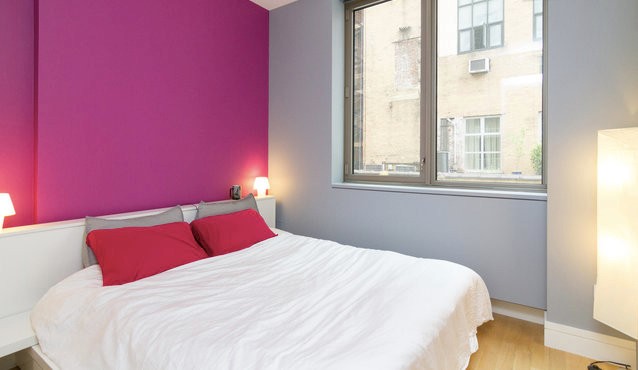
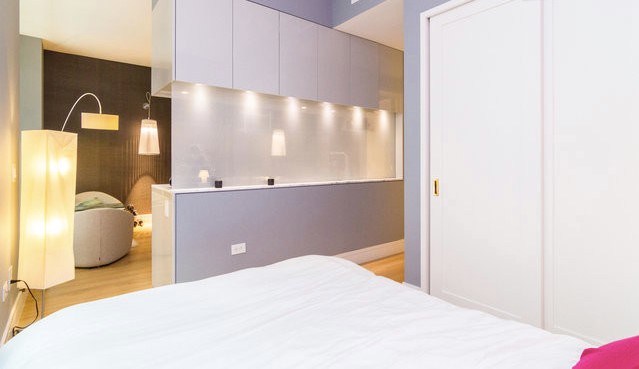
Unit 3C is located in Chelsea’s highly sought after Citizen Condominium at 124 West 23rd Street, with a 24-hour doorman, fitness room, bike storage, and private storage.

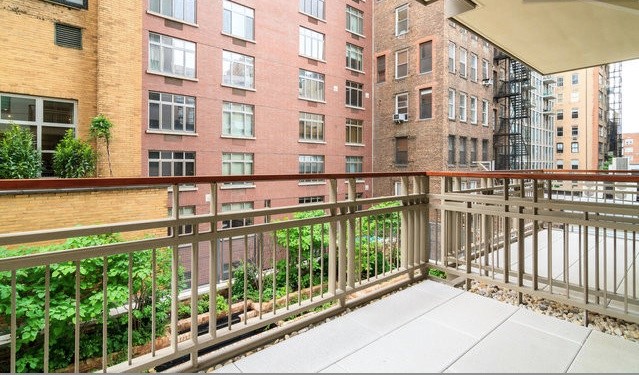
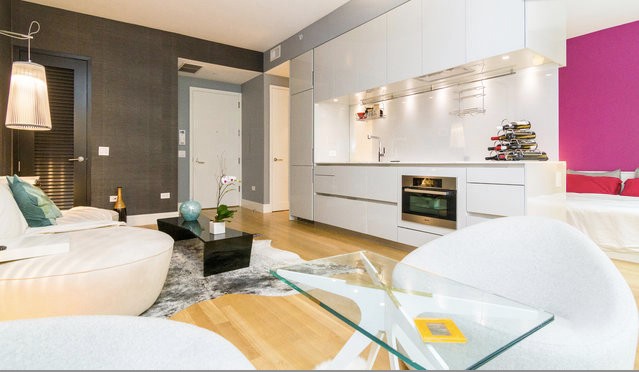
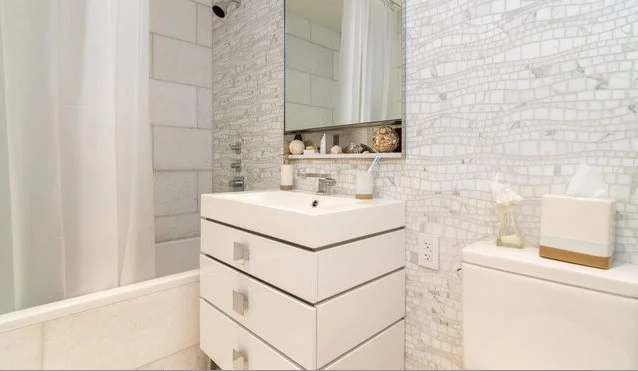
Unit 3C is an impeccably designed and finished with oak hardwood floors and high ceilings and floor-to-ceiling south facing windows. The apartment is sleek and modern with a loft-like layout and separate sleeping alcove, and open kitchen. Off the sun-filled living room is a spacious private balcony. The full sized kitchen is finished with top-of-the-line appliances and materials including European lacquer custom cabinetry, marble countertops, Miele dishwasher, SMEG high-end cooktop, and Sub-Zero refrigerator. The marble bathroom features high-end fixtures and soaking tub. This luxurious apartment is rounded out with private in-unit washer and dryer as well as central air-conditioning.

New Subway Cars Are In The Works

Gov. Andrew Cuomo revealed details of a new fleet of subway cars Monday, part of a “redesign of the MTA on every level” that will bear the unmistakable mark of Albany.

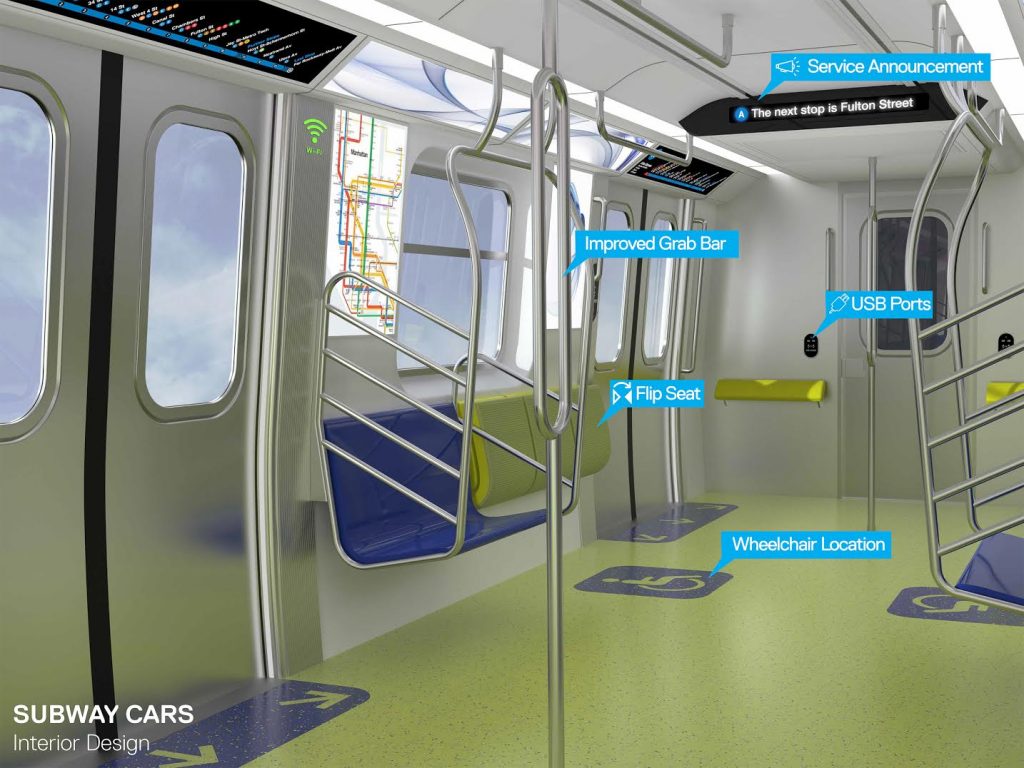
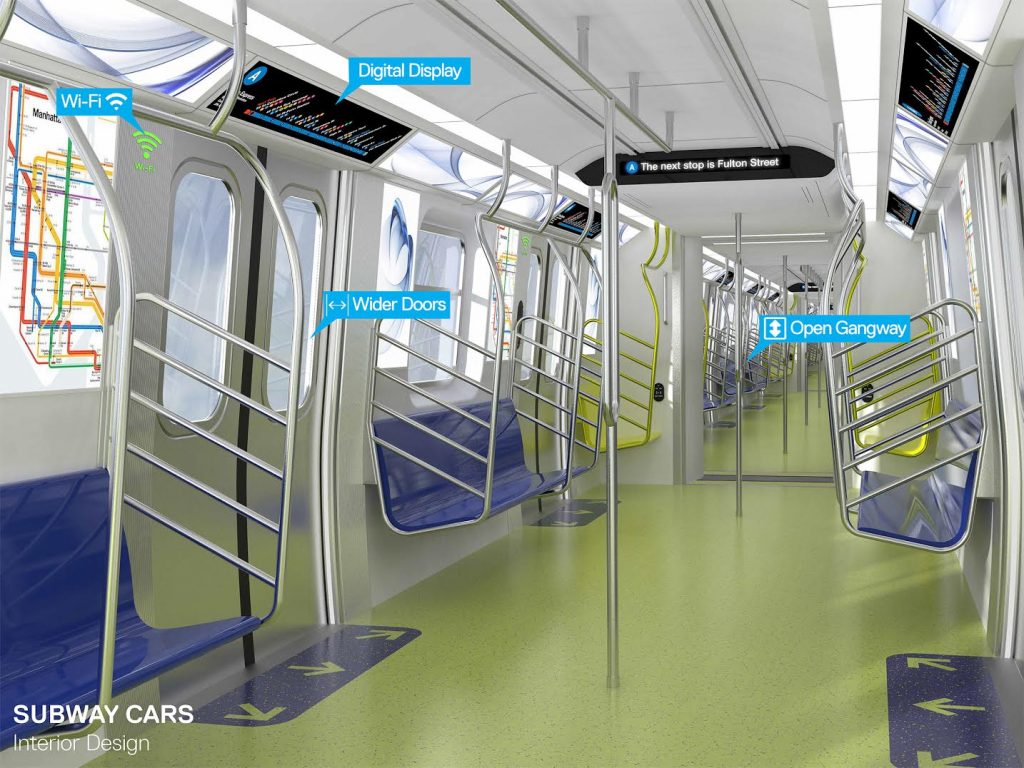
The Metropolitan Transportation Authority announced plans to build 1,025 new cars, which will feature Wi-Fi and USB jacks and connect openly to one another. A rendering of the new train showed a diagonal stripe of yellow and a panel of blue along the cars’ exterior, the latest sign that Cuomo is color-coding his legacy into the city’s transit system.

New buses that Cuomo deemed “Ferrari-like” in March and an e-ticket app that debuted this month feature the colors that New Yorkers might recognize from a state trooper’s car or all of Cuomo’s materials—blue and what this reporter mistakenly referred to as yellow at a press conference at the New York Transit Museum in Brooklyn. 

“The state color is not yellow,” Cuomo corrected. “Gold.”

Cuomo spoke at the New York Transit Museum in Brooklyn on Monday.

Cuomo’s office has previously denied a rebranding of the MTA in the state colors, but Cuomo said Monday it is “fair to say you’re seeing a redesign of the MTA on every level, and when you’re building new cars and you’re building new buses, you’re building new stations, etc., colors schemes are a part of that, and the attractiveness is part of that.”

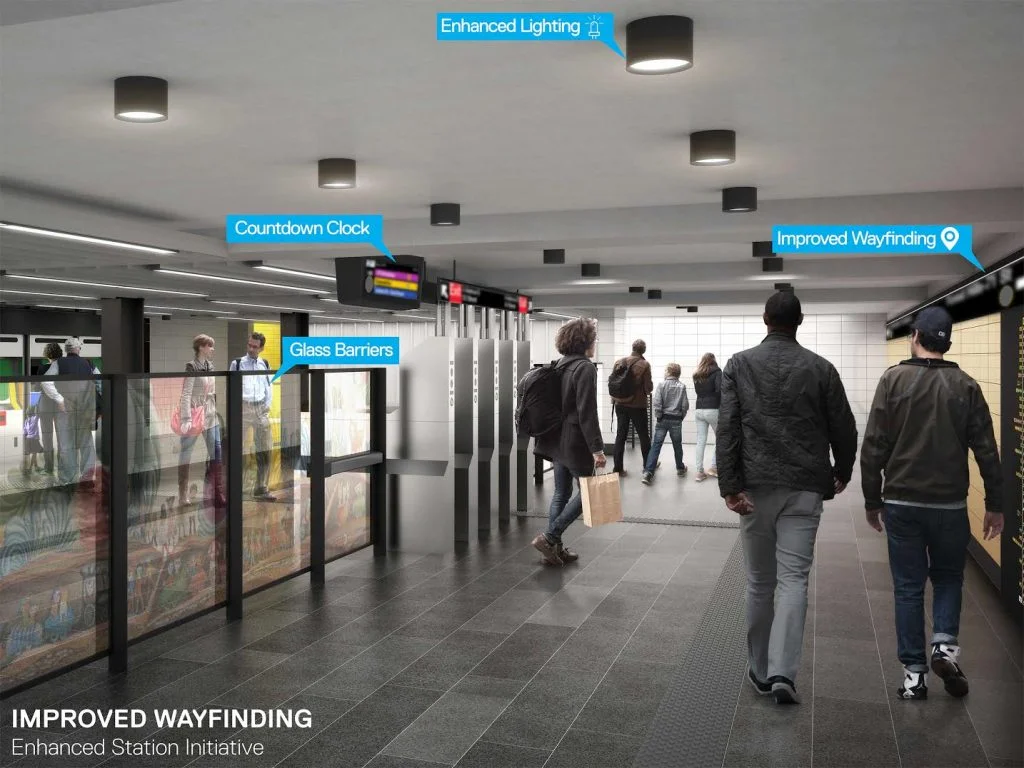
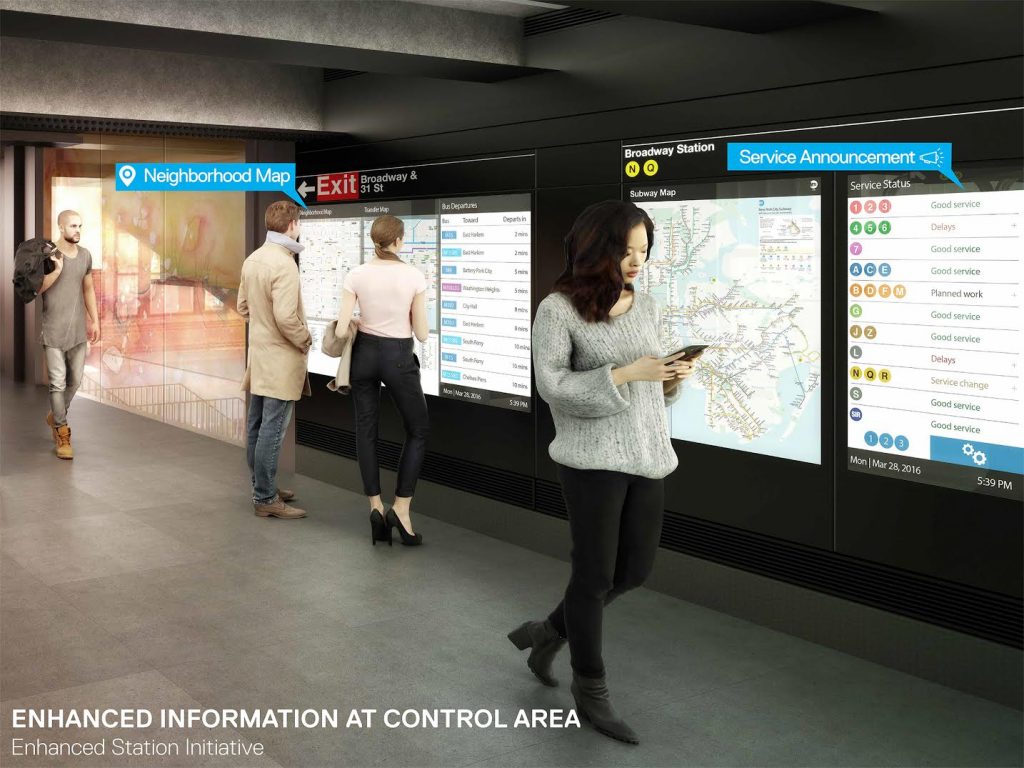
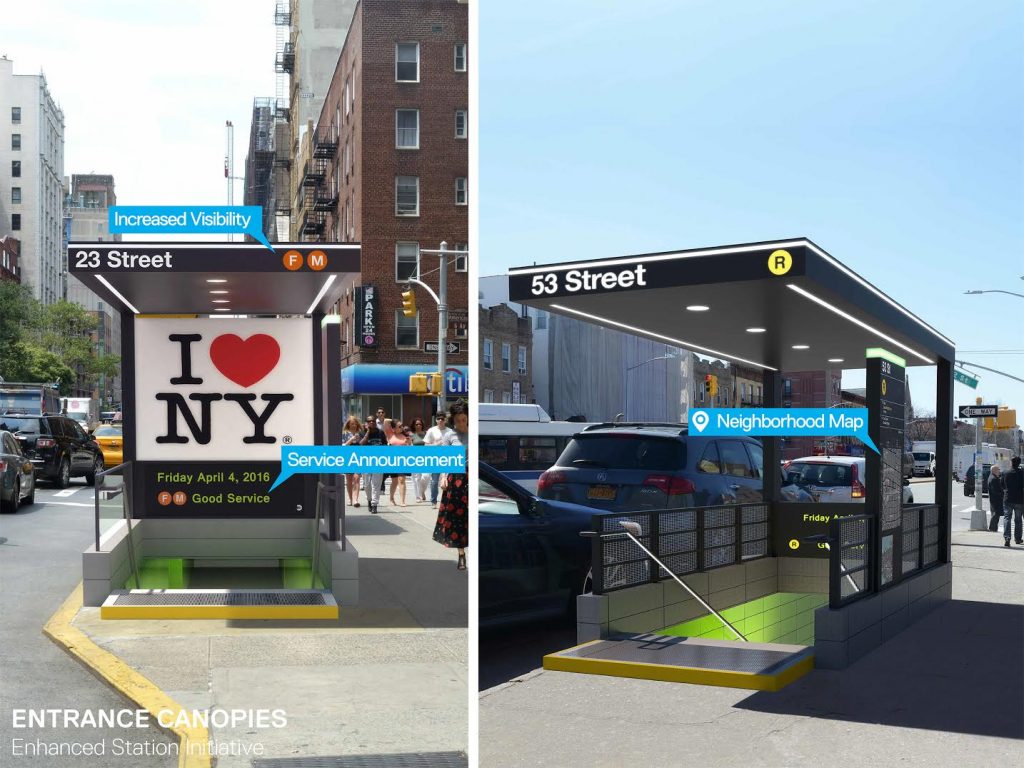
The new cars, announced as Mayor Bill de Blasio was heading to Italy for a week-long vacation, are part of the $27 billion, five-year MTA capital plan. The transit agency will also rebuild 31 subway stations across the five boroughs. Granite floors will replace concrete, and iron bars will be exchanged for glass barriers, according to the preliminary designs. At new subway entrances, the classic green globes are out, and electronic boards showing train status are in.

The governor has previously touted plans for Metro-North and the Long Island Railroad, but at Monday’s press conference he emphasized that the subways are a priority for him as well, though he would not expressly confirm his signature on the new cars.

“I’m sure [MTA] Chairman [Thomas] Prendergast, when he’s done, is going to put on every door and every train, ‘Thank you New York state for the $27 billion,’” Cuomo joked. “As long as the train is on time. If the train is not on time…”

The new cars will also feature open gangways, allowing movement along the entire train.

Not all of the $27 billion actually comes from the state. New York City, the federal government, and, of course, riders also contribute to the capital plan, which includes $15.8 billion for the city's transit system (the MTA also reaches seven suburban counties in New York). Also, the state has yet to identify the source of all of the funds it has committed, which has made transit advocates nervous.

Design experts Debbie Millman and Steven Heller, co-founders of the branding master’s program at the School of Visual Arts, said that if the color stamp is meant to refer to the governor, the signature is subtle.

“I’m a native New Yorker. I’ve lived in all the boroughs except the Bronx and I can tell you that I never once knew that the New York colors were blue and gold,” Millman said.

The e-ticket app colors looks orange and blue, she said.

“It really looks like it was sponsored by the Mets,” Millman said, whereas the buses “almost look more like the love child of the Mets and Citibank.”

Swapping classic blue-and-white buses for blue and gold seems “radical in terms of the identification of the city,” Heller said, and could have political meaning, especially in light of Cuomo’s relationship with the mayor.

"If you take into account Cuomo’s ongoing feud with de Blasio— which could be ego, it could be ideology, it could be any number of things—it’s kind of a slap in the face to a mayor to have something so overt changed on him,” he said.

Johnny Depp Re-Listed His Village In France For $55M Up From $26M

Most people, when their property doesn’t sell, lower the asking price. But then again, most people aren’t Johnny Depp. The movie star, who is currently going through a highly contentious and publicized divorce with Amber Heard, has just re-listed a village he owns in the south of France for $55 million — more than twice its original asking price of $26 million.

What prompted this change? Quite simply, “Mr. Depp feels that €50 million is the appropriate price for this asset,” one of his new brokers, Rick Hilton of Hilton & Hyland, told the Wall Street Journal. He claims that several billionaires are interested in the property.

Meanwhile, the CEO of Sotheby’s International France, which was originally listing the property, said its original price was already “ambitious” because it is “rustic” and 17 miles away from St. Tropez.

Depp bought the property in 2001 and spent $10 million on renovations that include turning a church into a guesthouse (a confessional is now a closet). There is also a 4,300-square-foot main house with five bedrooms, an art studio, a “Pirates of the Caribbean”-themed wine cave, a covered wagon that has a kitchen and bathroom, two swimming pools, a gym and a skate park.

Depp is also rumored to have recently sold off his palazzo in Venice, though the Times said that he never officially closed on the property. He also auctioned off nine of his Jean-Michel Basquiat paintings at an auction at Christie’s at the end of June.

Cute Midtown East Co-op With an Enormous Atrium Wants $999,000

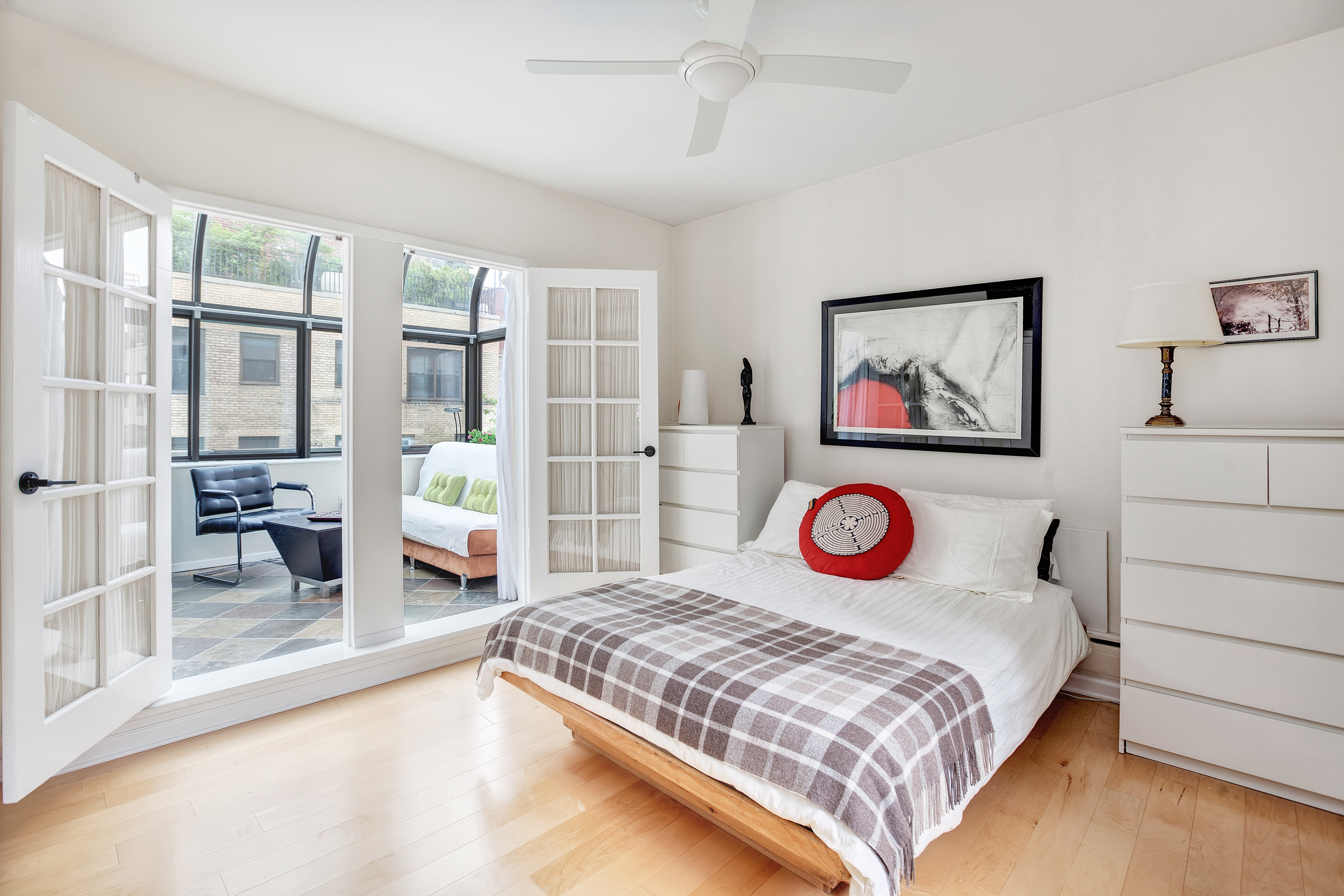
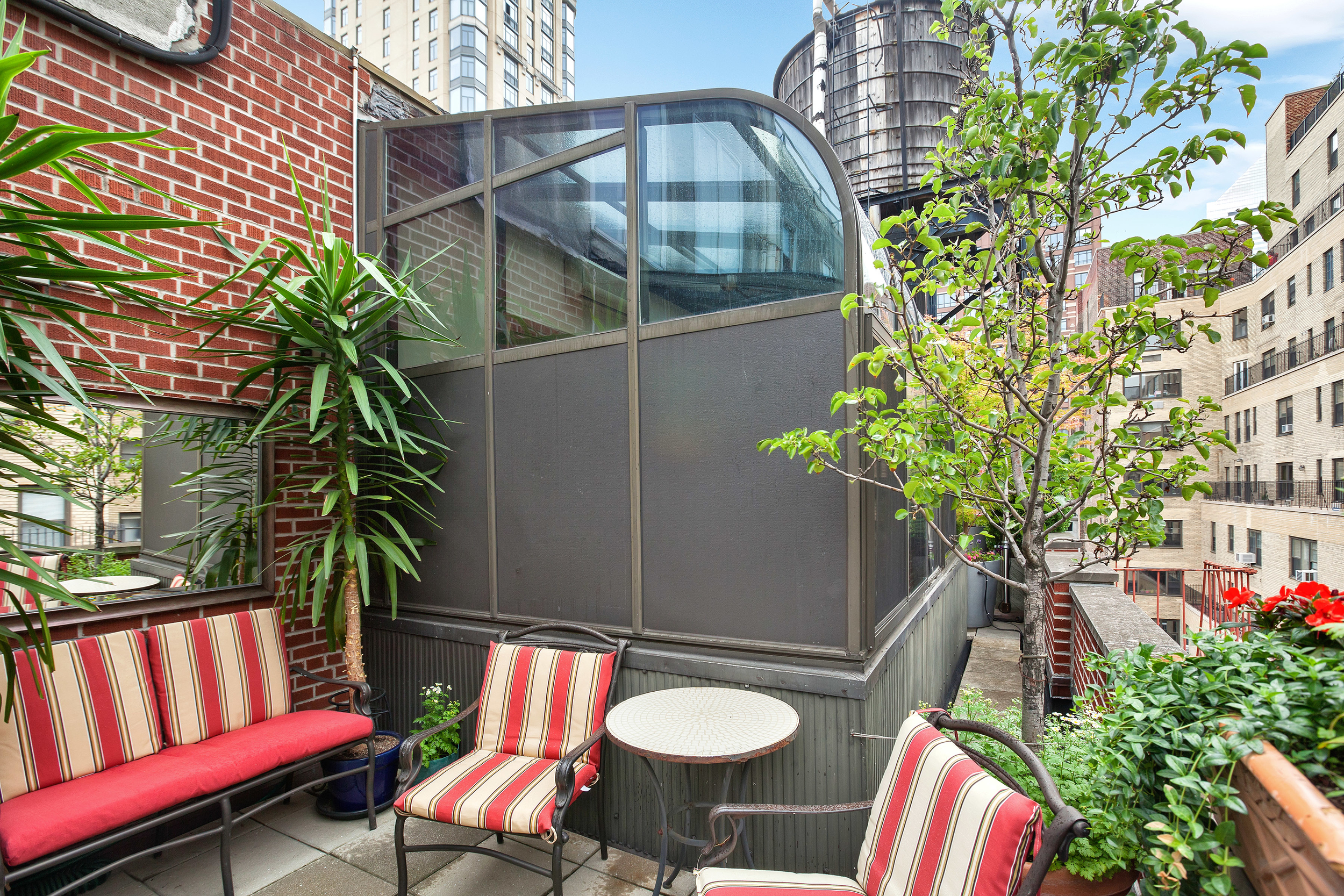
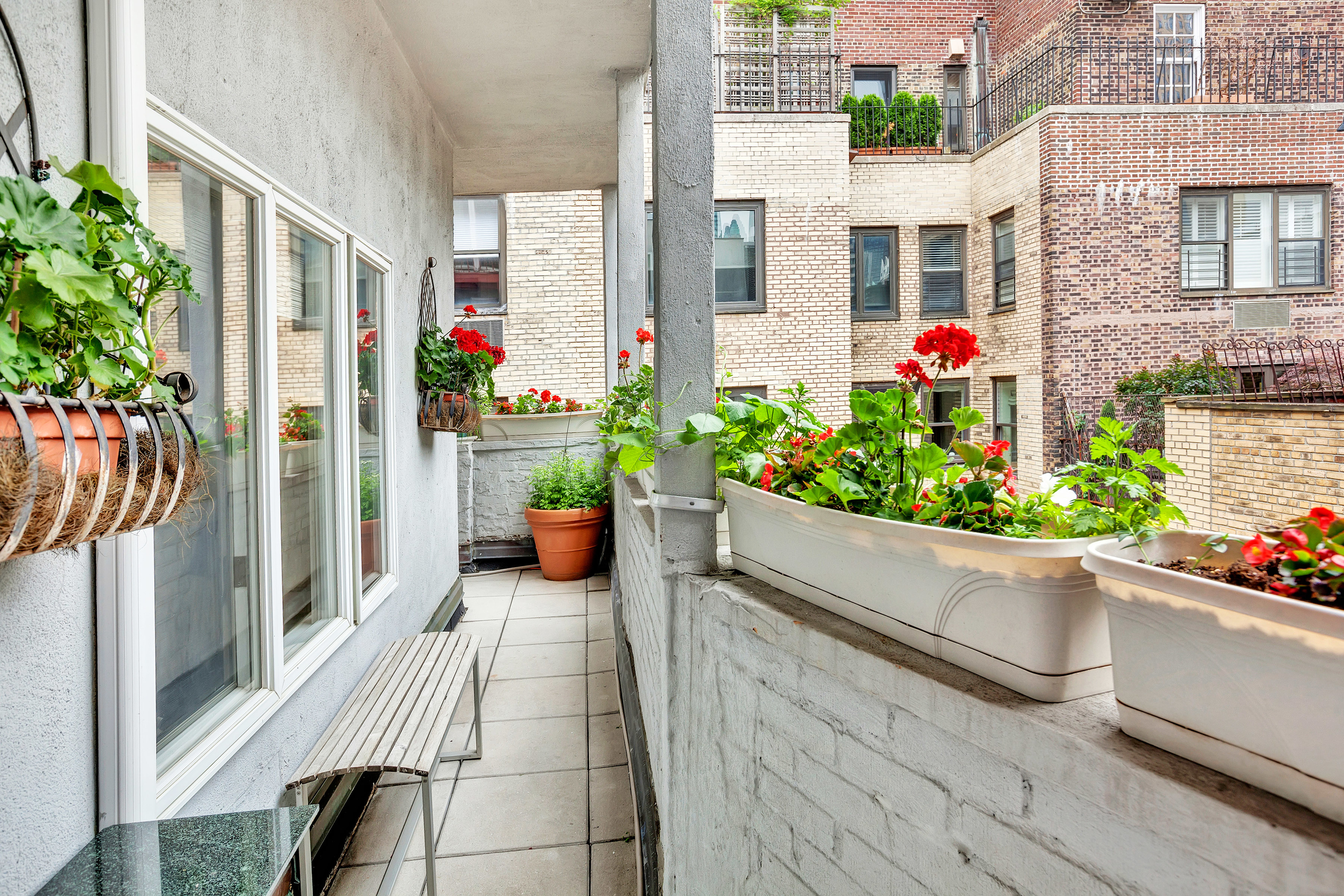
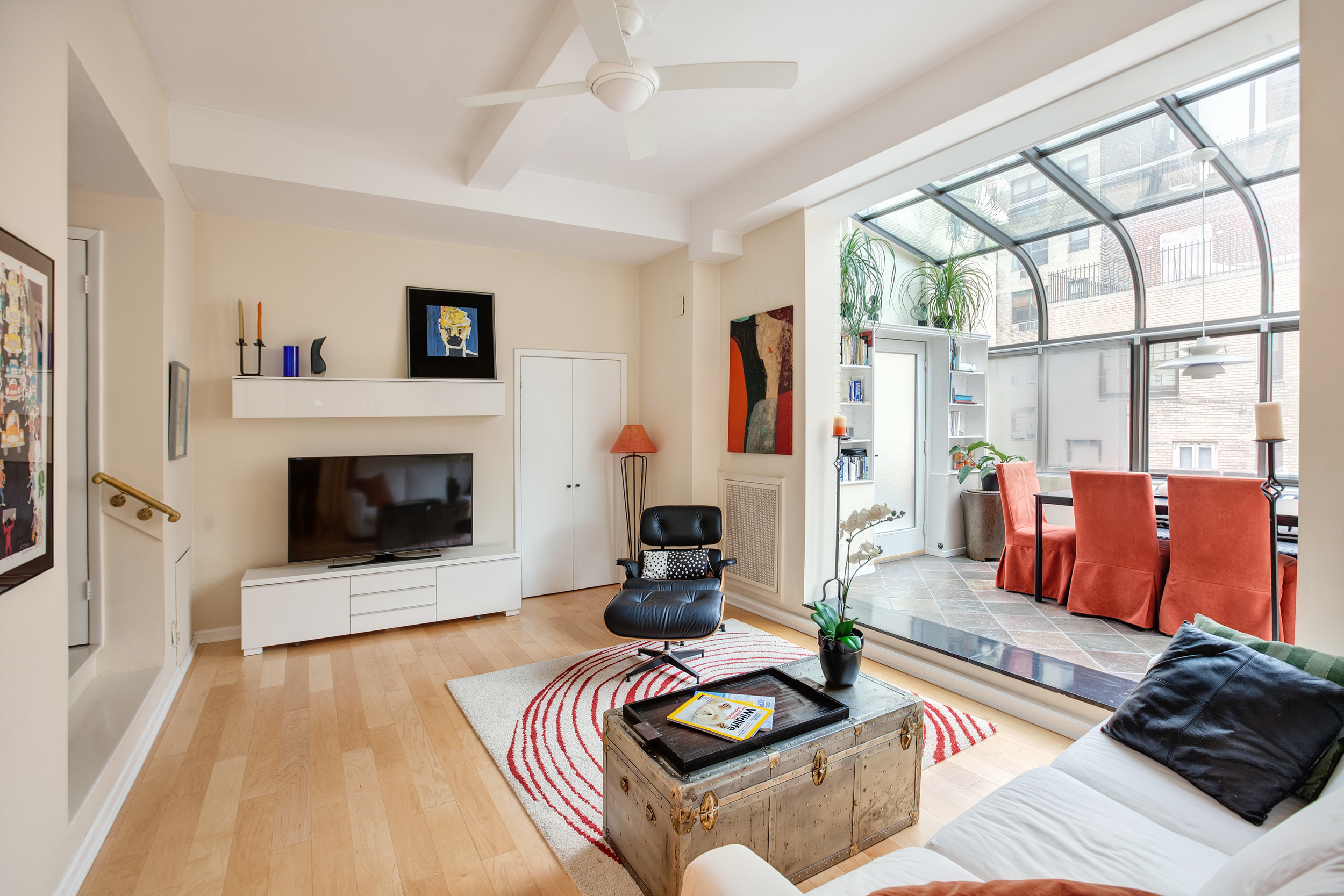
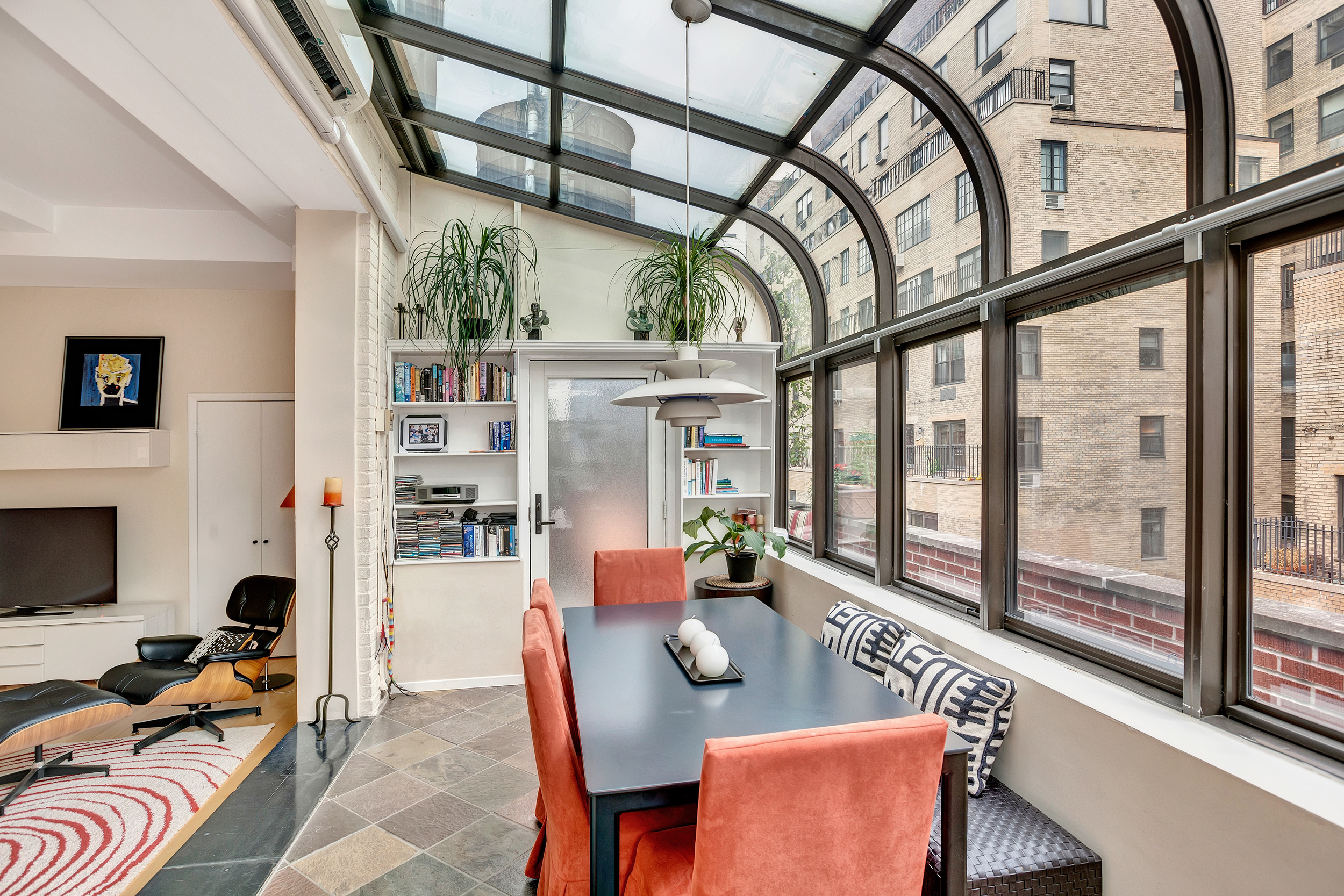
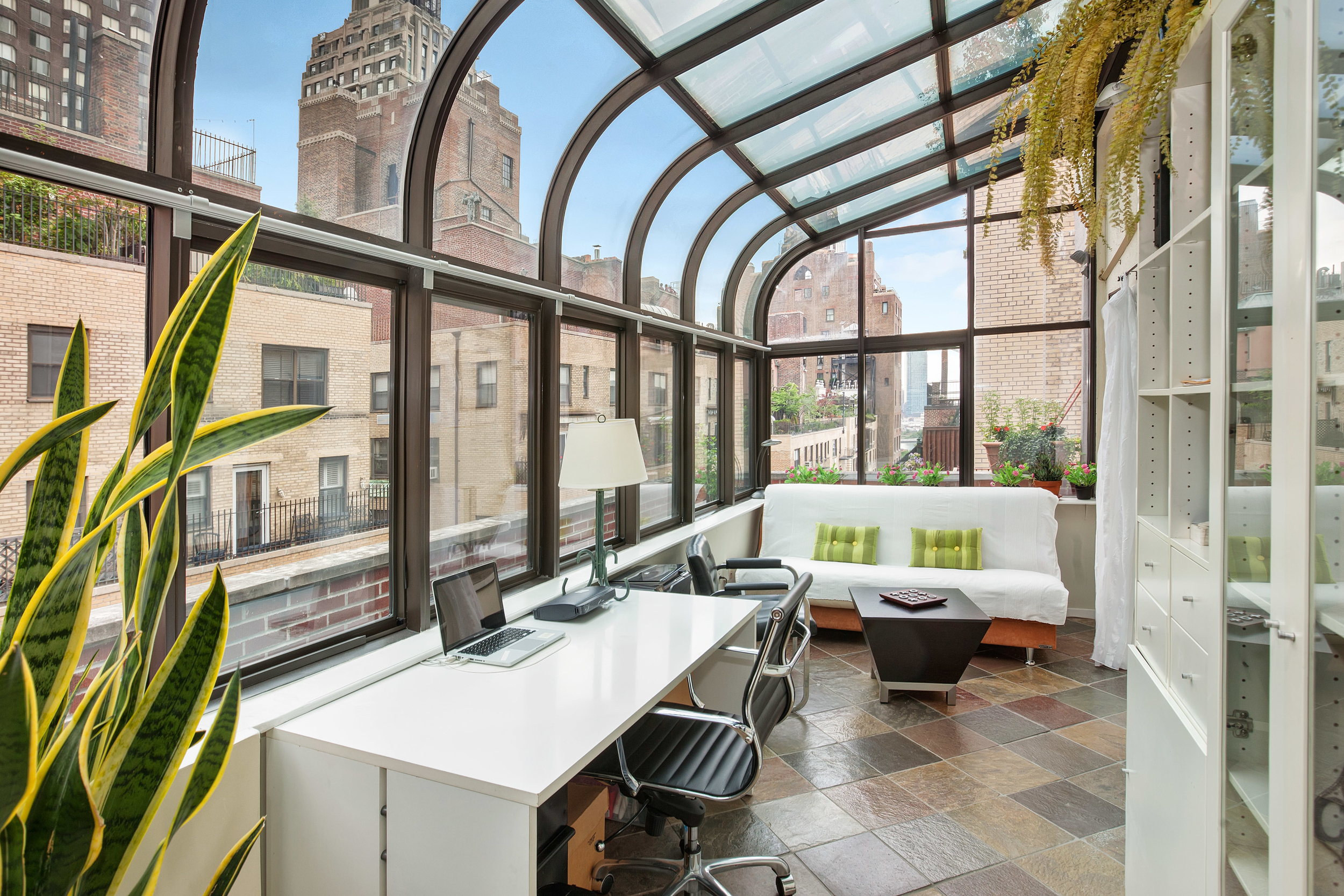
This one-bedroom apartment in the Beekman Hill House co-op would be fairly mundane if not for one glorious feature: it has a wraparound terrace that surrounds three sides of the apartment, along with a 32-foot glass-enclosed atrium. For someone who loves outdoor space, it could be the perfect pad.

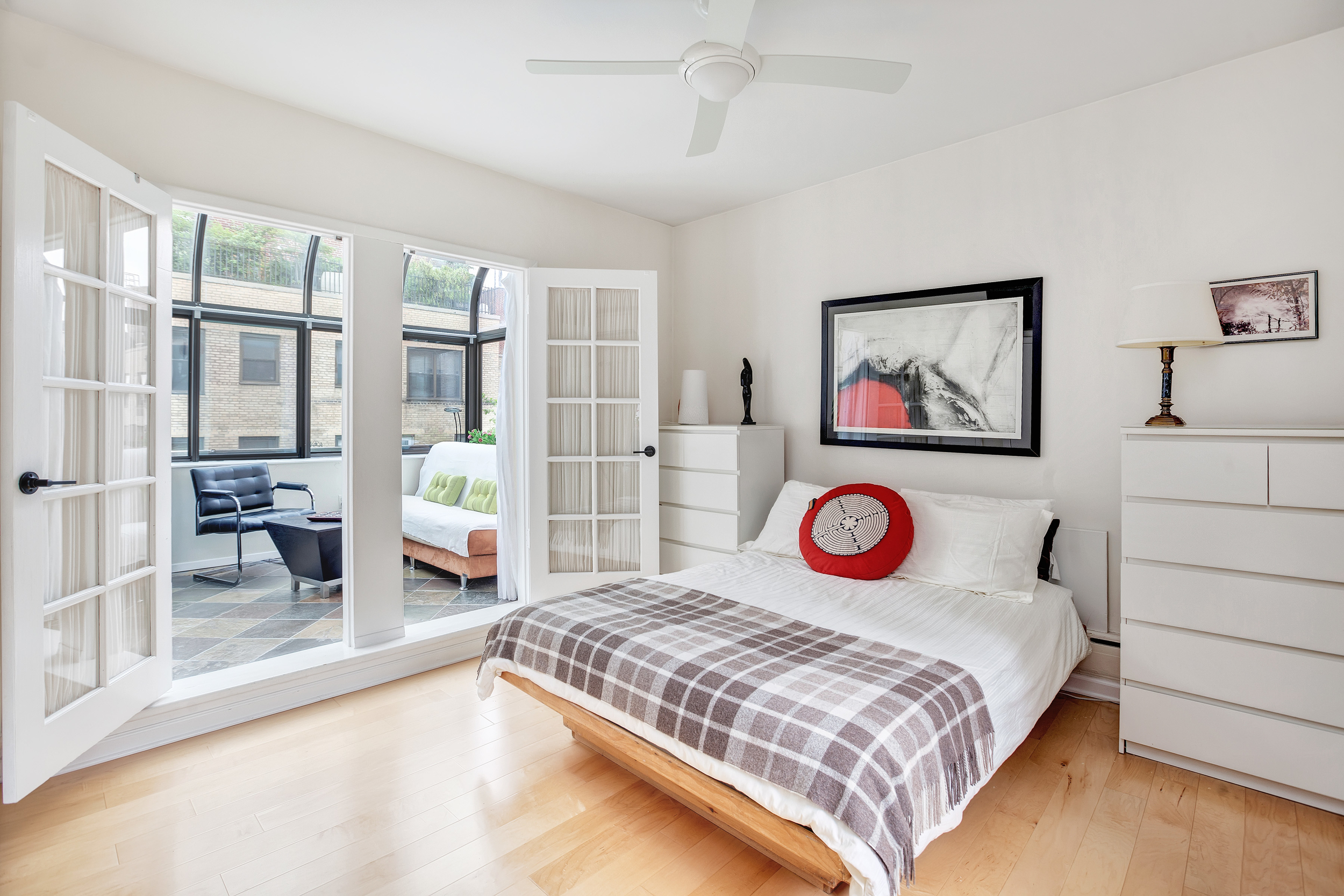
The apartment is otherwise pretty standard, with one nice-sized bedroom, a renovated kitchen, and a sunken living room. There are lots of nice touches, though, including the French doors that open from the bedroom onto the atrium, and the abundance of closet space. The building itself is also located on East 51st Street, which ends in a nifty little cul-de-sac that offers the illusion of privacy. One drawback: the high maintenance of $1,828 per month, which is on top of that $999,000 asking price.

Map Exposes NYC's Sprawling Subway Deserts

If you ride the subway to work in the morning, it may feel at times like you're part of a herd of cattle being kicked in the shins on the way to the slaughter, but here's a news flash for you: it could be worse. That's because a majority of the land mass of the city is not in easy walking distance to a subway station, and do you know how much of a pain in the neck it is to own a car around here?

Chris Whong works for the Department of City Planning by day, making maps and doing data analysis, and in his free time he makes still more maps for "fun." One he drew up last yearcaught our attention. It shows the areas more than 500 meters from a subway stop as islands floating apart from the well-serviced swaths of the city. Whong dashed off the map in about 30 minutes and was surprised when it garnered mentions from New York media outlets.

"It's something everybody can relate to," he said, reflecting on the attention the first map got. "I probably would have put more effort into it had I known."

Now, after a longer late-night mapmaking session, Whong has a new and improved version of the subway desert map that is easier on the eyes. Also, Whong took into account criticism that 500 meters or 0.3 miles as the crow flies is not the best measure of walkability, so this time he used OpenTripPlanner data to base the buffer zone on 10 minutes' walking distance from a given subway stop.

The resulting vision of New York is at once obvious and fascinating. Manhattan is heavily serviced by the subway apart from the East Village, and the far east and west sides. Much of the Bronx outside of four corridors is out of reach, as is most of the vastness of Queens, southeast Brooklyn, and the high-priced Williamsburg waterfront. Some of these areas are serviced by express buses, Metro North, and/or Long Island Rail Road, which Whong said he considered including. Ultimately, though, he opted to keep the concept simple (and cut out Staten Island—sorry SI Railway riders).

"There are lots of iterations," he said. "People have said 10 minutes is not too far to walk to the subway and 15 minutes is a better threshold for deserts. I encourage everybody to copy my methodology. There’s plenty of room for more analysis, but this was my cutoff point."

For instance, he said, using the same data sets, it would be possible to then incorporate census data and count how many people are within a certain distance of all subway lines, or a particular one, and how many people served by a particular public institution have ready access to a particular area.

Whong said the map made him appreciate living close to a subway station, and that the map could serve as a prompt for exploring lesser-known parts of the city, not that he has used it that way yet.

"It gives you a visual cue to explore them a little bit," he said. "You can visualize yourself there, zoom in on the map and look around, and say, 'Is that a place I should visit?' Because they’re not easy to get to."

Whong called the map an "open data success story," and praised the Department of Information Technology and Telecommunications, OpenStreetMap, and OpenTripPlanner, for providing the data he used, and Carto DB for the mapmaking platform.

The New Yorkers with the longest commutes tend to be struggling financially—two thirds of New Yorkers who commute more than an hour each way make less than $35,000. Politicians and activists have floated proposals to reduce fares for Metro North and LIRR train trips within the city, which the MTA is very tentatively looking into. Express bus trips currently cost $6.50, and an LIRR peak ticket from Jamaica to Atlantic Terminal will currently set you back $10. The J train from Jamaica, on the other hand, is torturously local if you're trying to get anywhere near Manhattan.

New Sales Listing - 425 East 51st Street, Unit 10D


425 East 51st Street, Unit 10D

Midtown East

New York, NY, 10022


Offered At $999,000

1 BED | 1 BATH

 View Floorplan  


Surround yourself in sunny vistas in this beautiful Beekman one-bedroom, one-bath home encircled by a breathtaking wraparound terrace and a 32-foot long atrium space.

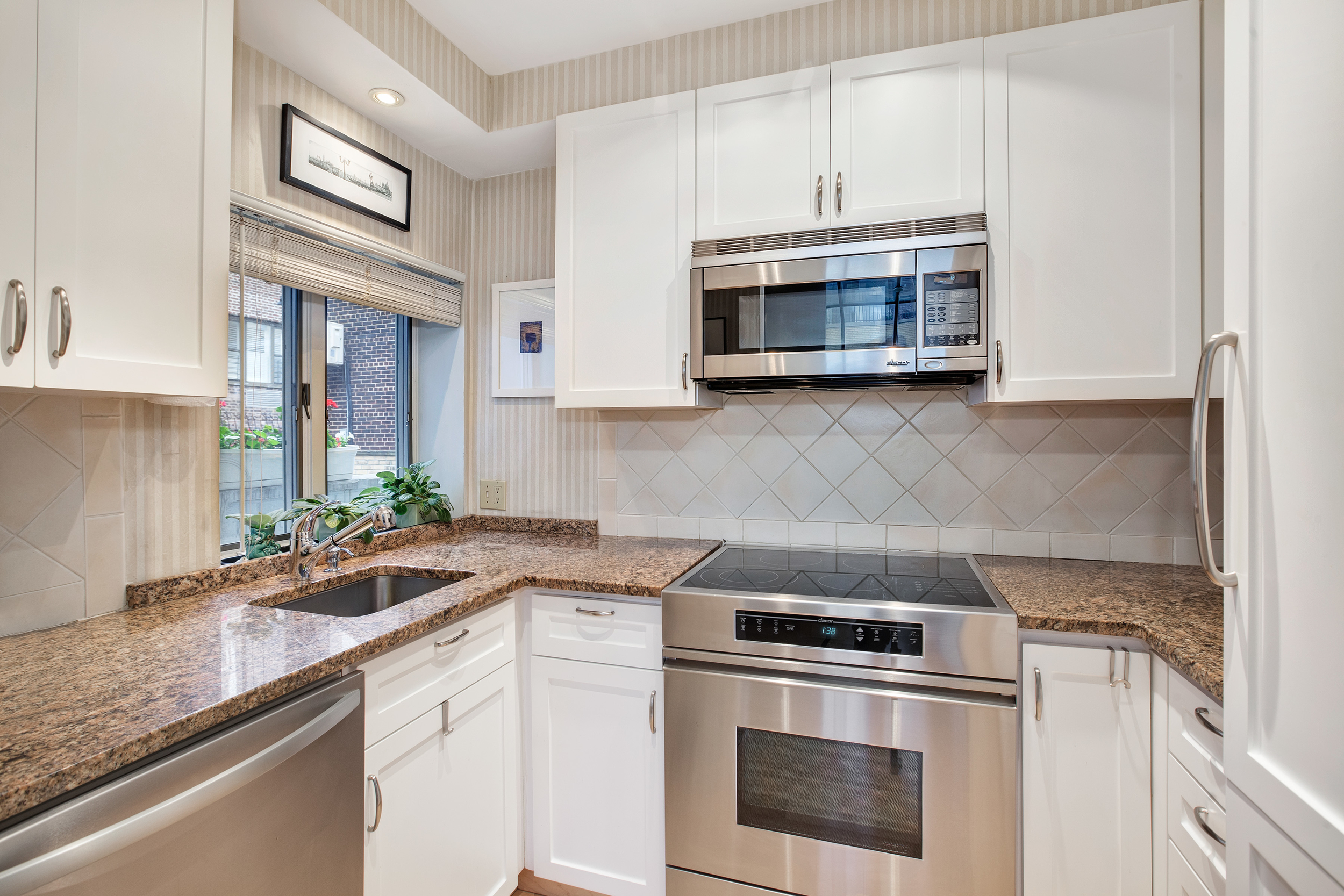
Enter the gracious foyer, flanked by two large closets, and step down into the large, airy living room. While sky-high ceilings rise overhead, you’ll be drawn to the bright atrium, providing an unbeatable dining room backdrop and splendid home office space. From here, step onto your private terrace wrapping a full 270 degrees around the home, providing ample room for multiple seating areas from which to enjoy jaw-dropping Midtown views in all directions. Back inside, the lovely updated kitchen stands ready to prepare quiet breakfasts or bountiful dinners, outfitted with full-sized stainless steel appliances, gorgeous granite counters and custom cabinetry. The roomy windowed bedroom features south-facing windows and two large closets, while the nearby bathroom includes a full bathtub.
 The apartment also features central air conditioning and additional storage space and built-ins add to the beauty and convenience of this gorgeous retreat in the sky.

Nestled on a pin-drop quiet cul-de-sac, The Beekman Hill House is a pet-friendly, pre-war cooperative featuring a part-time doorman, full-time porter, live-in superintendent, basement storage, laundry and a private garden. Delicious international cuisine dots the neighborhood, from formal French dining at Le Perigord and old-world Italian at DeGrezia to contemporary Mexican at Pampano. Lively wine bars and festive beer halls add to the nightlife options, while the services of Midtown offer every convenience. Transportation is excellent with E/M and 6 trains just blocks away.


Glamping Hits Manhattan With Outrageous $2,000/Night Hotel Suite

Glamping, one of the most cringe-worthy trends of 2014, is apparently still a thing. The movement of camping for people who don’t really like to camp has come to Manhattan with the Lexington Avenue W Hotel’s "Extreme Wow Outdoor Glamping Suite." To sum it up, the suite is a hotel room with a terrace designed by Laurel & Wolf and decked out with astroturf, a yurt, and some fancy lights. A press release elaborates,

The Outdoor Glamping Suite at W New York features dreamy nods to camping: a 12-foot yurt bedecked in a kaleidoscope of fabrics and textures, glowing lanterns, rattan hanging chairs and a fire pit that lights up with a flip of a switch. A canopy of twinkling café lights surrounds the yurt, the central element of the rustic-luxe oasis. With sweeping skyline views on the 17th floor, the Outdoor Glamping Suite will be available for guests to book from July 13th, 2016 through November 2016.

Let’s not belabor the point that this isn’t even glamping, which generally happens in some kind of wilderness, nor is glamping even camping. But this is a boon for those Manhattanites who, like on that episode of Sex and the City, believe there’s no world beyond their island. To reward that stubbornness, rates for the suite start at $2,000/night.

LinkNYC Kiosks Clogging Sidewalks With Encampments and Drug Deals

The city's LinkNYC kiosks are taking over the neighborhood, residents say, crowding sidewalks with as many as four to one block and drawing users who've been seen camping out on the street to plug into them.

The city installed at least 40 new Link NYC kiosks on the Upper East Side beginning in March, and residents say they've created a nuisance in the neighborhood due to the size and density of the machines.

While the kiosks, which stand 9-feet 6-inches tall, have so far only been installed in spots where public pay phones used to be, more are coming, with the city's goal to bring 4,550 of the machines to the city by July 2019, according to CityBridge, which operates LinkNYC.

"These are extremely intrusive and extremely large," said resident Betty Cooper Wallerstein. "If they were alone, I might not have an objection to the size, but they're not alone. There are all kinds of structures along the street."

The kiosks — which offer free access to Wi-Fi, phones, phone chargers and internet browsers — have also become spots for drug deals, according to some residents.

The NYPD did not respond to requests for more information.

Valerie Mason, the president of the East 72nd Street Neighborhood Association, said she saw drug deals happen in front of two ;kiosks in her neighborhood on the Fourth of July. The dealers were makings phone calls and handing over plastic baggies, she said.

"Why are we going back to the 1970s? That really wasn't a great period in New York City," Mason said during a Community Board 8 meeting on July 6. "Why would you want somebody to have unlimited access like that to create a crime scene in the middle of Manhattan?"

Mason also noted seeing a man sleeping in a plush recliner while plugged into a kiosk at East 49th Street and Third Avenue on July 4. Similar encampments were documented in photos posted on social media, including one in front of a kiosk on 35th Street and Third Avenue.

During the July 6 CB8 meeting, members and residents said they are concerned for the safety of the neighborhood and the city should have come to them for their input before installing the machines.

“The process has been subverted here by [Department of Information Technology & Telecommunications] and LinkedNYC,” said committee member Barry Schneider. “We are advisory...except if we are not asked, we cannot advise."

A spokeswoman for LinkNYC said that it was not the company's intention to have people take advantage of the kiosks and said some measures have already been taken, like lowering the volume allowed at night, to curb some noise complaints they have received.

On the east side, the kiosks have so far been installed along Third Avenue from East 59th to East 96th streets, and up north as far as East Harlem and The Bronx and as far south as the Lower East Side.

Some blocks have a higher concentration of the machines than others though, residents said, including at 68th and 69th streets, 76th and 77th streets, and through the 80s — with as many as four kiosks on one block.

The city only requires the kiosks be located at least 50 feet from each other, according to a City Hall spokeswoman.

"The ideal would be 260 or 300 feet between them so you don't have to put more than one tower at each block," said Lo van der Valk, president of Carnegie Hill Neighbors. "There should have been an attempt to make the proliferation less."

The kiosks were also installed on the west side along Eighth Avenue and parts of Broadway from West 13th to West 145th streets.

The LinkNYC spokeswoman said that the size of the machines is as small as the company could make them to fit the necessary technology inside and that the Public Design Commission worked with the Department of Information Technology & Telecommunications on locations.

But had the city come to the community first before setting plans in place, the crowding could have been avoided, according to van der Valk.

"The public review process is backwards and forwards," he said during the board meeting last week. "Here, now we have a chance to talk about it because people on this board raised issue with it."

Community board members said they would work with LinkNYC and the city to set up a meeting about current and planned kiosk locations on the Upper East Side.

The city plans to install 4,550 kiosks across the city by July 2019, according to the city’s agreement with CityBridge. Additionally, at least 7,500 kiosks will be installed by July 2023.

Below is a map of locations where phone booths exist(ed), and where LinkNYC kiosks will be installed.

The New York Times on Monday Declared An End To The “Ultraluxury Real Estate Frenzy,”

The New York Times on Monday declared an end to the “ultraluxury real estate frenzy,” citing a serious disconnect between supply and demand. The newspaper pointed to an excess of high-priced inventory flooding the market, even as fewer captains of the universe seem willing to make splashy purchases. The Gray Lady followed in the footsteps of the Wall Street Journal, which reached a similar conclusion in May.

More than a year ago, however, well before the talk of doom and gloom became commonplace, The Real Deal attempted to quantify the demand for top-shelf product. We found that developers had perhaps made too much of a bet on the very top of the market — a bet that is now coming back to give them serious headaches.

As developers look to recalibrate, it’s worth revisiting that story here: “How much demand actually exists for uber-luxury condos?

This Week’s 5 Most Expensive Listings

In the past seven days, six new listings priced at $10 million and above hit the market, according to StreetEasy. From that list, these are the crème de la crème, otherwise known as the five most expensive residential listings to hit the Manhattan market.


123 Washington Street #56

Address 123 Washington Street #56
Price $23,000,000
Type/Size Condo: 12 bedrooms and nine bathrooms
This week’s most expensive listing is just a touch untraditional. From the looks of the broker-babble, it’s six units spread across the 56th floor of the W Hotel’s residences Downtown. Each of the units – which range from one bed, one bath to two bed and two bath – comes with high ceilings, lots of sunlight, and open city views.


71 Laight Street #Phc

Address 71 Laight Street #Phc 
Price $20,000,000
Type/Size Condo: four bedrooms and five bathrooms
From the look of StreetEasy’s records, this penthouse has been trying to sell (without budging in price) since 2013. The 4,986-square foot duplex sits atop Tribeca’s Sterling Mason building and comes with a double-height foyer, a library and a 1,065-square foot private terrace.


100 East 53rd Street #49A

Address 100 East 53rd Street #49A
Price $14,750,000
Type/Size Condo: three bedrooms and three-and-a-half bathrooms
This 3,385 square-foot residence is in a tower which is still under construction. When complete, this Foster + Partners’ designed building will give residents access to a host of hotel-like amenities including a wellness facility, sauna, steam room, and residential library. Don’t start packing yet – occupancy is slated for spring 2017.


252 East 57th Street #61A

Address 252 East 57th Street #61A
Price $12,950,000
Type/Size Condo: five bedrooms and six-and-a-half bathrooms
Curved glass buildings are so hot right now. This 4,624 square-foot home is joining the likes of 100 East 53rd (above) and 520 West 28th with its curvaceous oversized windows. It also comes with expansive views, a balcony, and a library, while the building itself offers amenities including a porte-cochere, a spa, a billiards room, and a screening room.


888 Park Avenue #12B

Address 888 Park Avenue #12B
Price $12,000,000
Type/Size Co-op: five bedrooms and four-and-a-half bathrooms
This Upper East Side spread seems to have been flirting with the market since 2008, and since then it’s chopped $1 million from its price tag. It comes with a formal living room, a banquet-sized dining room, a chef’s kitchen, butler’s pantry and breakfast room.

Bill de Blasio Thinks The City Can Stop Dumping Its Garbage By 2030

Most cities use machines to hoist their garbage from curb to truck. New York has guys like Julius Brewster. The 56-year-old works most nights from 7 p.m. to 4 a.m. hauling commercial waste for Metropolitan Recycling in Brooklyn.

“The smell used to get to me,” Brewster said from behind the wheel of his 22-ton truck on a recent Wednesday.

Brewster and his partner hopped out at the corner of Avenue U and 26th Street in Sheepshead Bay to throw heavy cardboard boxes piled with rotting fruit into the maw of the truck. When some of the slop fell to the pavement, Brewster scooped it up with his hands.

“My father told me, ‘You stay in the garbage business and you’ll never get laid off,” said Brewster, who’s been collecting trash since he was 17. “There’s always more garbage.”

Keeping it all out of landfills by 2030 isn’t just ambitious, it’s pretty much impossible.

New Yorkers generate more than 44 million pounds of residential and commercial waste every day, almost a ton per person per year. Only a third of it is recycled, composted or burned to generate energy. The rest is dumped, some as far away as Kentucky. Mayor Bill de Blasio wants to radically change that equation. Last year, he pledged that New York would send “zero waste” to landfills by 2030. “This is the way of the future if we’re going to save our Earth,” he said.

But anyone who knows anything about waste in New York seems to agree: Keeping it all out of landfills by 2030 isn’t just ambitious, it’s pretty much impossible.

“This zero-waste idea seems to be without any real plan behind it,” said Kendall Christiansen, manager of the New York City chapter of the National Waste & Recycling Association. “Other cities, like Austin and Calgary, went through a very deliberate process of developing a detailed set of goals and plans to achieve them. New York’s plan has been pretty loose, without much public discussion, just rhetoric.”

The job of coordinating this moon shot appears to fall to the city’s Department of Sanitation. Commissioner Kathryn Garcia recently sat in her wood-paneled office on Worth Street to talk about how she planned to eliminate the city’s residential waste.


NIGHT HAWK: Julius Brewster rides the streets at night collecting commercial waste.

“We’re focusing on our low-diversion areas,” she said. “Brownstone Brooklyn, there’s not much more I can get out of them. To bring the overall city rate up, you need to be in areas where the environmental message may not be resonating.”

The mayor raised eyebrows when he appointed Garcia in 2014. As chief operating officer of the Department of Environmental Protection, she got the city’s sewage-treatment plants back online after Hurricane Sandy. But Sanitation can be tough on newcomers, and Garcia was filling the well-worn boots of John Doherty, who began as a trash collector in 1960.

She has since won over her critics, but the job ahead is tough. Since Staten Island’s Fresh Kills dump was closed in 2001, fewer places want to take New York’s trash, and they are asking more money for it. In May, the Seneca Meadows landfill, 270 miles northwest of the city, backed out of a $3.3 billion, 20-year deal to take New York’s waste.

The problem for Garcia is that New Yorkers have few incentives to throw away less. At home and at work, it is often easier and cheaper to put things in black bags rather than in colored bins down the hall. “Unless it’s convenient, people won’t do it,” she said. Getting to zero, Garcia explained, will demand a complete rethink of how the city handles its trash.

“Garcia is one of the most innovative commissioners I’ve worked with,” said Greg Bianco, chief executive of Metropolitan Recycling. “It’s not an easy thing she’s trying to do.”

Excess capacity

To understand the scale of the problem, visit the 11-acre Sunset Park Material Recovery Facility on the Brooklyn waterfront, where nearly all of the recyclables collected by Sanitation Department workers end up. In a space the size of an airplane hangar, barges and trucks dump plastic bags filled with recyclables into enormous piles. A fragrant mix of brine, rot, old milk and stale beer hangs in the air, and swallows flit around the building’s beams. The $120 million facility opened in late 2013. Most of it was paid for by taxpayers, but $55 million came from Sims Municipal Recycling, the local arm of a global scrap-metal and electronics recycling firm, which won a 20-year contract to process and market the metal, glass, plastic and some of the paper collected from homes, public schools and government buildings.

Optical sorters, drum magnets and massive machines called ballistics separators make recycling at Sunset Park a mostly automated process. “From a manpower standpoint, it’s extremely efficient,” said Tom Outerbridge, who runs the plant and joined Sims in 2003 after a decade of recycling consulting and some years with the Sanitation Department. “Most facilities have one or two optical sorters. We have 16.”

Recycling is a capital-intensive, high-volume, low-margin business. Sims’ long contract created an incentive to invest in top-of-the-line equipment. That should make recycling more cost-effective for the city. The Sanitation Department pays Sims around $75 to process a ton of recycling, but $90 to $100 to dump a ton of waste in a landfill or burn it in a waste-to-energy plant. When the market for recycled commodities is good, the city shares in the profits.

Facts

16% RECYCLED: The portion of New York City waste that's recycled. 
2,000 POUNDS: The amount of trash each New Yorker produces annually. 
$449: What the Department of Sanitation spends to collect a ton of trash in New York City.

Outerbridge has a front-row perspective on just how haphazardly New Yorkers recycle. Gazing at a new hoard of dumped material, Outerbridge grimaced at an unrecyclable wicker basket. His eyes then wandered to glass jars filled with baby food. “We would’ve preferred they empty that out,” he said, “but what are you going to do?” There is no market for mixed glass—most recyclers either sell it at a loss or dump it in landfills—but clear glass, if separated out, fetches more than $30 a ton.

New York City may have the largest curbside recycling program in North America, collecting around 500,000 tons of recyclable material a year, but it should be much more, Outerbridge said. Twenty-seven years after the city required residents to sort their trash, they do so at the anemic rate of 16%. Half the recyclable waste is going to landfills.

Recycling rates for businesses average around 19%. But because private-sector haulers self-report their data, it is hard to know just how much is kept out of landfills. The lesson for Outerbridge is simple: “Without public participation, you can build the fanciest recycling plant in the world and you don’t have anything.”

High cost of collection

Many American cities treat waste as a utility and charge people for what they generate. In Los Angeles and San Antonio, residents pay based on the size of their homes. In San Francisco and Seattle they are charged for the trash they set out, while collection of recyclables is either cheaper or free. In Houston,  households receive one free trash bin but must pay for any additional bins or bags.

New York is different. The city uses general tax revenue to cover residential and public waste collection, so residents have few incentives to recycle or produce less waste. New York also has the nation’s highest collection costs at $449 per ton for the Sanitation Department. In Washington, D.C., it’s $212.

Anxiety over climate change may motivate Upper East Siders, who recycle nearly a quarter of their waste. But something else is needed in poor areas such as Mott Haven and Port Morris in the Bronx, where diversion rates hover below 6%.

The city is considering a collection charge. “When something costs you money, you pay more attention,” Garcia said in her office. She pointed to the way water usage dropped when the city stopped charging flat rates for water and installed meters. “In the 1980s, New York City used 1.5 billion gallons of water. It’s under 1 billion gallons today and we have a million more people.”

Imposing a trash charge will be difficult. Mayor Michael Bloomberg liked the idea, but the City Council saw it as a new tax.

New York also has more apartment buildings than any other U.S. city, making it especially hard to penalize and reward individual behavior.

“Recycling is all about creating a social norm,” said Chaz Miller, director of national policy at the National Waste & Recycling Association. “This is easy to do when everyone sees what their neighbors are putting out on the curbside. In multifamily homes, it’s much harder.”

The tight spaces in which New Yorkers live make it difficult to store garbage in separate bins. The city aims to solve this problem by letting residents put all their recyclables in a single bag by 2020. Single-stream recycling would also let the Sanitation Department send out one recycling truck per route instead of two.

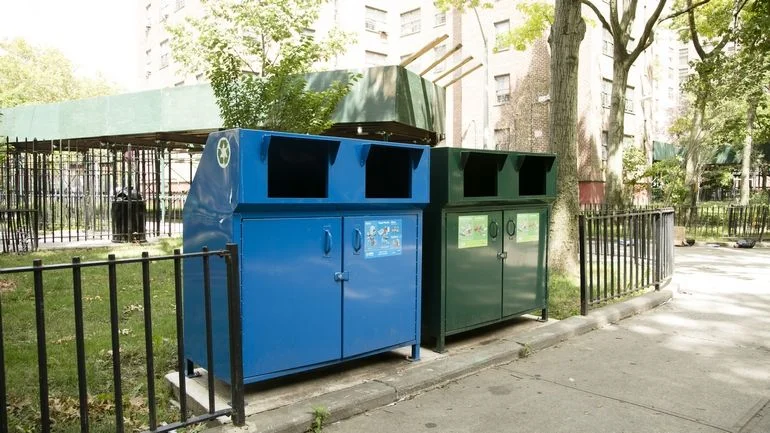
The city’s recycling challenges are particularly acute in public housing, where one in 10 New Yorkers lives.“When I got here, a chief said, ‘They pretend to recycle and I pretend to collect it,’ ” Garcia said of New York City Housing Authority buildings. The de Blasio administration has begun introducing recycling to these developments, but it is not easy. Most have no indoor space for bins, so the only place to toss cans and paper is outside.

Photo: Buck EnnisDOING HER PART: Hazel Duke, 84, who lives in the Gowanus Houses says she sorts her trash despite the inconvenience.

At the Gowanus Houses in Brooklyn, Isabella Hernandez said the new bins in the courtyard are easy to ignore. “Who wants to go downstairs to go recycle when it’s so far away?” she said.

Hazel Duke, an 84-year-old resident of the Gowanus Houses, said she sorts her trash despite the inconvenience. “It’s a hassle for me because I can hardly walk.”

Another Gowanus Houses resident, who calls herself “Miss Dee,” is happy to recycle, just not quite in the way the city hopes. In her fifth-floor apartment she collects empty plastic bottles and soda cans on her dining table. When she has enough to fill a cart, she heads to the redemption center around the corner. “Last time I got $9,” she said.

New York’s litter-fighting bottle bill offers a nickel for each redeemed bottle or can. Private redemption centers sell the empties back to beverage distributors at a small profit. But New Yorkers who try to live off these fees often collect plastic bottles and aluminum cans from bags of already-sorted recyclables, reducing the value of what arrives at facilities like Sims’.

“Our aluminum bales in New York are worth less than in New Jersey, where there is no bottle bill,” Outerbridge said. “We’re talking roughly 12 to 15 cents a pound, which adds up when you’re selling thousands of tons.” Scavengers take about 70,000 tons of material from recycling bins a year, a city study found. That means the only real incentive many New Yorkers have to recycle comes at a cost to the city.

New Yorkers’ habits at home are just one piece in a complicated puzzle. Businesses have their own system for managing waste, with practices dictated largely by the market.

More than 200 private carters pick up from hundreds of thousands of businesses. Thatseems inefficient, but Ben Velocci, principal of Bronx-based Avid Waste Inc., has little patience for critics. “All of the solid waste collected by private haulers is done without any help from the city,” he said. “New York City provides no transfer stations, no recycling facilities, no composting, but we still make sure thousands of tons of trash disappear every night.”

Private carters

New York privatized collection for businesses in the 1950s, but only after the city flushed out the mob in the late 1990s did the industry become safe for legitimate players. Now, private carters—from mom-and-pops to 100-truck goliaths—jockey for contracts with every office building, nail salon and grocery store. The Business Integrity Commission, which oversees their practices, limits their contracts to two years and caps their rates without a floor.

The opportunities of this free market inspired Velocci to start Avid Waste in 2005.  Private carters “deal with a lot of regulations,” he said. “It’s why there are no national waste companies here.” The hustle was apparently too much for Houston-based Waste Management, which sold its local hauling operation in 2007. Republic Industries followed suit in 2010.

Photo: Buck EnnisPLASTIC PEAK: A pile of mixed recyclables waiting to be sorted at Sims' Sunset Park recycling facility.

Competition for contracts creates some value: New York’s businesses pay less than half the $1.7 billion the city spends to collect and dispose of a similar amount on the public side. Yet because different haulers serve businesses on the same block, private trucks drive a collective 47 million miles a year—nearly four times the distance covered by the city’s trucks.

The prices carters get for recycled material also affects their willingness to pick it up. “When commodity prices are low, recycling rates are lower,” Velocci said. High landfill fees nudge some recycling—paper is so valuable that Avidpicks it up for free. But for metal, glass and plastic, Avid charges around 60% to 70% of the price of garbage collection—not enough savings for most businesses to bother sorting, he said.

Volatile commodity prices, capped rates and a two-year limit on private-hauling contracts deter big investments in private recycling plants. Other cities often subsidize recycling facilities to ensure the machinery keeps humming when commodity prices drop. Not New York. “The private sector can’t run a facility that isn’t going to be profitable,” said Velocci.

The city is introducing new recycling rules that could simplify things for businesses, but they will likely raise carting costs further. Starting in August, every business must sort paper, cardboard, metal, glass and plastic into either two streams or one.

“They should’ve talked to us first,” said Tom Toscano of Mr. T Carting, a hauler that runs its own $2 million facility for recycling paper and cardboard. His customers don’t pay for cardboard pickup, but this will change if they throw all their recyclables into one bag. “I’ll have all these extra costs in breaking that bag open, putting materials through different conveyor belts,” he said. “I have to charge customers for that. I’m not making that money back.”

Don’t mention glass to him. “There’s no market for it. It gets in conveyors, it gets in sorters, it jams up materials,” said Toscano.

Carters are concerned by a proposal City Hall is reviewing to divide New York into zones and have private haulers compete for longer contracts, with clear diversion targets.

“Without certainty of business, haulers will never do the work necessary to reach zero waste,” said Greg Good, who is overseeing Los Angeles’ move to a franchise zoning system. The bids L.A. received show private haulers will adhere to higher standards and invest in equipment to keep waste out of landfills if they have the right incentives, he said.

Organics chemistry

Food scraps and yard waste make up at least a third of the waste stream, and when dumped in landfills release methane, a greenhouse gas six times more potent than carbon dioxide. Keeping this waste out of landfills is the trickiest part of getting to zero.

Since 2013, brown bins for organic waste have been placed in select neighborhoods and schools. The pilot program now serves over 700,000 residents, and de Blasio boldly claims all New Yorkers will be composting by 2018. But the material the city collects is often too contaminated to be used, and a Delaware composting facility that took most of the city’s organics closed in 2014 after locals protested the odors.

“They really need to invest in some education,” Toscano said of the city’s pilot, which offers little instruction on the brown bins. “People are throwing diapers in there, people are throwing in whole cans of food. It’s awful.”

Mr. T Carting is one of several companies with contracts to clean up the residential organics stream. Separating bottle caps from banana peels will cost taxpayers up to 50% more than dumping garbage. Toscano now has a year or so to ready his transfer station. The city already spends a bundle on collecting and schlepping organics to processors hundreds of miles away. The Citizens Budget Commission said citywide composting could cost $250 million a year, and a commission survey of composting facilities within 150 miles found capacity for only 10% of the city’s organic waste.

What may be a tricky job for residents is about to become a costly undertaking for businesses. Starting this summer, the city is also requiring large food manufacturers, arenas, stadiums and restaurants in hotels with at least 150 rooms to keep their organic waste out of trash bins.

Samuel Linder, the Swiss-born chef of the Peninsula New York hotel, said he is startled by how wasteful New York is. The problem begins before the food arrives in his kitchen. “Literally two boxes of soft-shell crabs will give you half a container of waste.” In Switzerland, food is delivered in washable, reusable crates. “That doesn’t exist here.” The city’s failureto reduce troublesome materials, notably polystyrene foam and plastic bags (“The most time-consuming contaminant,” said Outerbridge), has not helped.

Linder is eager to green his kitchen, but said he was surprised by the cost. He cites the extra bins, separate pickups for organics and recyclables, and the time spent training staff. The hotel has bought a stainless steel machine called an ORCA that in one hour breaks down 25 pounds of food waste into effluent that’s flushed down the drain (creating a sewage treatment headache of its own). “It’s a lot more work for us,” he said.

When Massachusetts banned the dumping of commercial food waste in 2014, the state paid for new infrastructure, a renewable-energy tax credit and research on the technologies available to process organics on-site.

New York City will levy fines on businesses that don’t comply with its new organics policy, but offers no incentives. That may not be enough to meet de Blasio’s zero-waste goal.

“It’s unrealistic to think you’re going to have high rates by government fiat,” and New Yorkers will need incentives to make sorting their trash worth their while, said Velocci of Avid Waste.

Looking over his half-empty recycling facility, Sims’ Outerbridge agrees that big goals still have value, especially with the city’s population expected to reach 8.8 million in 2030. The mayor’s priorities are in the right place, he said, “but when you start digging into it, how do we get there?”

The World's Top-Earning Celebrity In 2016

Swift has nabbed the top spot on the 2016 Forbes Celebrity 100 list. The singer earned an estimated $170 million in the past year, driven in part by her very successful 1989 World Tour. Swift more than doubled her take from last year, when she earned $80 million.

"She smashed the Rolling Stones' North American touring record, grossing $200 million on the continent en route to quarter of a billion dollars in total," Forbes reports. "She also pads her pocketbook by shilling for brands including Diet Coke, Keds and Apple."

Musical artists One Direction came in second on this year's list with $110 million. Rounding out the top 5 were author James Patterson ($95 million); talk show host Dr. Phil McGraw and soccer superstar Cristiano Ronaldo (both $88 million); and comedian Kevin Hart ($87.5 million).

The top 10 list of highest-paid celebs is as follows:

1. Taylor Swift ($170 million)

2. One Direction ($110 million)

3. James Patterson ($95 million)

4. Dr. Phil McGraw ($88 million)

5. Cristiano Ronaldo ($88 million)

6. Kevin Hart ($87.5 million)

7. Howard Stern ($85 million)

8. Lionel Messi ($81.5 million)

9. Adele ($80.5 million)

10. Rush Limbaugh ($79 million)


One sad note: Had Swift stayed with her now ex-boo, superstar DJ/producer Calvin Harris, she would have topped two lists.

With his $63 million in earnings, the pair would have been the top-earning Celebrity 100 couple, outpacing Beyonce and Jay Z, who earned a combined $107.5 million over the past year.

Shake it off, Taylor -- there's always next year.

New Sales Listing - 33 Greenwich Avenue, Unit 12B


33 Greenwich Avenue, Unit 12BWest Village, Manhattan, NY, 10014


1 BED
1 BATH
Offered At $1,195,000


South-west facing, renovated, high-floor, corner one-bedroom, one-bathroom apartment with dual exposures and a private outdoor terrace offering unobstructed views over the West Village. 

Flooded with sunlight, this apartment has undergone a gut renovation and features an open kitchen with Cesarstone counters, Bosch dishwasher and oven, Jennair stove top, Summit refrigerator and freezer, all of which are concealed by custom cabinetry. Heated floors in the bathroom and kitchen will keep you toasty in the winter, while the roomy bedroom with two exposures is outfitted with CitiQuiet windows to ensure a peaceful night's sleep. The 30-foot private terrace delivers gorgeous sunsets and unobstructed views down to the Hudson River, perfect for private outdoor dinners, BBQ’s or entertaining guests.

Additional owner upgrades include in-wall HDMI cabling in the bedroom, and in-wall speakers / projector in the living room.
 The windowed bathroom offers a textured ceramic stone floor, glass and marble wall tiles, a built-in cabinet with heated glass, a heated towel rail and a tub with built-in shower and glass screen.

33 Greenwich Avenue is a full-service co-op situated in the heart of the historic West Village offering full-time doorman, live-in super, parking garage, storage, gym, laundry, bike room and a landscaped roof deck, with views of the Empire State Building. Pied à terres, co-purchasing and gifting are allowed with board approval. Subletting is permitted after two years, for one year at a time for a maximum of two years over a five-year period. Pets are allowed with board approval. Famous Village restaurants and vibrant nightlife dot the area, while the adjacent Meatpacking District, SoHo, and Union Square neighborhoods mean the best of Lower Manhattan is within easy reach. Transportation is phenomenal with A/C/E, B/D/F/M, 1, L and PATH trains nearby.

Smart Or Greedy?

When 15 Central Park West was set to kick off construction in 2005, the building’s co-developer William Zeckendorf made what would turn out to be a prescient purchase. He paid his firm, Zeckendorf Development, $10.7 million for a three-bedroom pad on the 41st floor. The building went on to become the most successful condominium in New York’s history, the “Limestone Jesus” of luxury living. And Zeckendorf’s $10.7 million bet netted him, in the span of just five years, a profit of more than $30 million.

“Don’t get high on your own supply,” Michelle Pfeiffer’s character warned in the 1980s cult classic “Scarface.” But many developers who’ve ignored that maxim have come out on top.

Sponsors buying their own product is so commonplace in New York real estate that brokers use it as a marketing tactic, banks set limits on how many units a sponsor can take out of circulation and buyers have come to like the perks of calling developers their “neighbor.”

One key reason developers buy in is to reap the rewards of an appreciating product, insiders said.

“The downside of building a condo is, once you’ve sold, if the building continues to appreciate in value, the developer doesn’t participate in that,” said Scott Singer, president of the Singer & Bassuk Organization. “So it’s a way to participate in future increases.” At 15 CPW, for example, the average price per square foot has risen steadily nearly every year since its launch, according to data from CityRealty. When sales kicked off in 2007, units at the building traded at an average of $2,614 per square foot, a number that jumped to $4,706 by 2010.

While none of the developers contacted for this story agreed to speak on the record, details gleaned from public records shed light on their purchases.

Miki Naftali

Some recent deals involving sponsors include the Naftali Group’s Miki Naftali, who picked up a $6 million penthouse at his 182 West 82nd Street project this year, and Ian Schrager, who forked over $15 million at his 160 Leroy StreetZiel Feldmanowns a pad at the Marquand, a Beaux-Arts mansion at 11 East 68th Street that his HFZ Capital Group converted into condos in 2013, while Alchemy Properties’ Ken Horn owns an apartment at the Isis at 303 East 77th Street. JDS Development Group’s Michael Stern owns a $16 million pad at Walker Tower at 212 East 18th Street, which his firm developed with Property Markets Group. PMG principals Kevin Maloney and Elliott Joseph own condos there, too. Madison Equities’Robert Gladstone plans to move into 212 Fifth Avenue, a project he’s co-developing with Building and Land Technology.

Another member of this club is Donald Trump.  The presidential candidate reportedly held on to dozens of apartments at Trump Parc at 106 Central Park South and Trump Park Avenue at 502 Park Avenue. Last year, he sold a penthouse at Trump Park Avenue for $21.4 million, or $3,453 per foot, and earlier this year, the Trump Organization sold a full-floor unit at the building for $14.05 million, or $3,345 per foot.

The sales were not related to funding his campaign, Trump’s daughter Ivanka Trump told the Wall Street Journal at the time. “We sell units when the market is conducive to selling,” she said.

PMG’s Maloney and Joseph seem to share the sentiment.

Maloney, who shelled out $11.4 million for an 18th-floor pad at Walker Tower in 2014, listed it last year for $15.65 million. He also offered the apartment as part of a three-unit spread asking $60 million, or $6,000 per foot. Joseph owned the other two units in the package, having paid a combined $22.9 million for them.

Though the combination sale never happened, Joseph was able to sell one of his units, 18C, for $10.4 million in September, 82 percent more than the $4.7 million he paid in 2014. His other unit, Unit 18A, which is currently in contract, was last asking $25.5 million, a nearly 50 percent markup over his purchase price of $17.2 million.

Michael Graves

Douglas Elliman’s Michael Graves, who represented the PMG principals in the sales, declined to comment specifically on the deals. But he said sponsors often “cherry pick” units they feel will soar in value.

“A lot of developers are looking for units that are malleable to make larger,” Graves said, and if a developer thinks large units will make a killing in the next real estate cycle, he or she may purchase adjacent, smaller units that can be combined when the time is right.

“It would make you scratch your head if a developer was not interested in buying their units for a long-term investment,” he added.

From a lender’s perspective, however, developers holding onto units can complicate deals.

“There’s nothing wrong with it, but the lender has to look at the likelihood of being repaid in full and what’s their cushion from the rest of the units,” Singer said.

If a developer offers to buy an apartment for $1 when it’s worth $1 million, that deal lowers the building’s total sellout and the potential earnings the developer would use to repay the bank. But if a developer offers a fair-market price for the pad, lenders may be heartened to see a contract signed early in the process.

“It would make you scratch your head if a developer was not interested in buying their units for a long-term investment,” — Michael Graves.

To protect their interest, some lenders limit the number of units a developers can hold off the general market. Brokerages, too, push for a cap on the amount of inventory a developer can buy themselves, or sell to friends and family, since those deals often exclude brokerage fees.

Above all, banks want to know they’re being repaid, said Aaron Shmulewitz, an attorney at Belkin Burden Wenig & Goldman. “Lenders like to see sales, not unsold units,” he said, adding that sponsors also walk a fine line between snagging themselves a good deal and adversely affecting comps in the building.

For these reasons, it’s rare to see developers gift themselves or their relatives units. At DDG’s 41 Bond Street, for example, CEO Joe McMillan forked over $6.2 million to buy out his investment partners and become the sole owner of a first-floor unit, property records show.

Howard Lorber

But “friends and family” discounts are par for the course, and allow developers and their bosom buddies to invest early in a building and ride the wave of price appreciations.

Earlier this year, for example, Douglas Elliman chair Howard Lorber paid a “friends and family” price of just over $15 million for a half-floor pad on the 67th floor of 432 Park Avenue, where his brokerage is handling on-site sales for Macklowe Properties and CIM Group.  The price for his 4,000-square-foot pad worked out to $3,750 per foot. His neighbor on the same floor, neither friend nor family, paid $26.6 million, or over $6,650 per foot.

In “House of Outrageous Fortune,” which chronicled the rise of 15 CPW, author Michael Gross said a number of early buyers – including the Zeckendorfs, their equity partner Eyal Ofer and his brother, Idan, as well as Goldman Sachs’ Lloyd Blankfein, former Treasury Secretary Henry Paulson and Justin Metz, then a Goldman real estate executive – all received fat discounts on their pads.

Blankfein, for example, paid $25.7 million, or $4,262 per foot, for a duplex that was asking $29 million, according to Gross. The apartments now on the market at the building are asking, on average, $6,670 per foot, according to CityRealty.

According to Gross, each “insider” deal at 15 CPW varied, but some received 6 percent off the initial ask plus an additional 3 percent “friends and family” discount. All benefited from being first movers: Five days after sales launched, the developers raised prices – the first of 30 such increases.

“Developers have been involved in the building from Day 1, so they know how the sausage is made and still want to live there.” — Jonathan Miller

Aaron Appel, a managing director in JLL’s real estate investment banking practice, said sponsors who put their money into condos may see a tax upside: After 12 months of ownership, the unit is subject to capital gains tax versus ordinary income tax. “I have a lot of clients who buy and hold for tax purposes,” he said.

And from a marketing standpoint, developers’ purchases can certainly look good to potential buyers, and early contracts from friends and family — many of them high-fliers in their own right — can help generate buzz. Buyers may see it as sponsors putting their money where their mouths are.

“Developers have been involved in the building from Day 1, so they know how the sausage is made and still want to live there,” said Jonathan Miller, CEO of real estate appraisal firm Miller Samuel.

Douglas Elliman’s Vickey Barron, who headed up sales at Walker Tower, said the fact that Stern lived in the building was an effective sales tool. “I used to say, ‘Michael is going to live in the building,’” she said. “It really does go a long way.”

Other developers like the ability to trick out their apartments to a degree that wouldn’t be possible in someone else’s finished product. Related Companies CEO Jeff Blau, for example, helped design his own penthouse at the Chatham, a Robert A.M. Stern-designed condominium developed by Related at 181 East 65th Street. Stern, too, keeps an apartment at the building.

His boss, Related chair Stephen Ross, currently has one of the best commutes in the city, from his sprawling penthouse at the Time Warner Center, which Related developed in 2003, to Related’s corporate offices below. And he intends to keep it that way: Related will soon be moving its corporate headquarters to its Hudson Yards megaproject, and Ross will move his home there, too.

This Evening - Manhattanhenge 2016

Photographers and photo enthusiasts get ready.

Each year in May and again in July, New York City has the opportunity to experience Manhattanhenge - the phenomenal moment when the sun aligns perfectly with the city’s grid and gives us the chance to catch a glimpse of the sunset from east to west streets in Manhattan.

If you love sunsets and appreciate Manhattan's urban terrain, then you should make sure you have your camera (or smartphone) charged-up and ready to go at the end of this month and also in July. 

RELATED: MAP: How to see Manhattanhenge May 29 - 30 (2015)

According to the American Museum of Natural History, Manhattanhenge will take place on the following days and times to see the half sunset on Manhattan’s grid. 

Half
May 29, 8:12 p.m.
July 12, 8:20 p.m.

Below are the dates and time to see the full sunset along Manhattan’s grid.

Full
May 30 8:12 p.m.
July 11 8:20 p.m.

The Hayden Planetarium will be hosting a special public program on Tuesday, July 12 at 7 p.m. which will include a presentation by astrophsicist Jackie Faherty discussing the history and astronomy behind Manhattanhenge. 

You will be able to view Manhattanhenge from various points in the city but the best spots to see it are: 14th Street, 23rd Street, 34th Street, 42nd Street, and 57th Street looking west.